
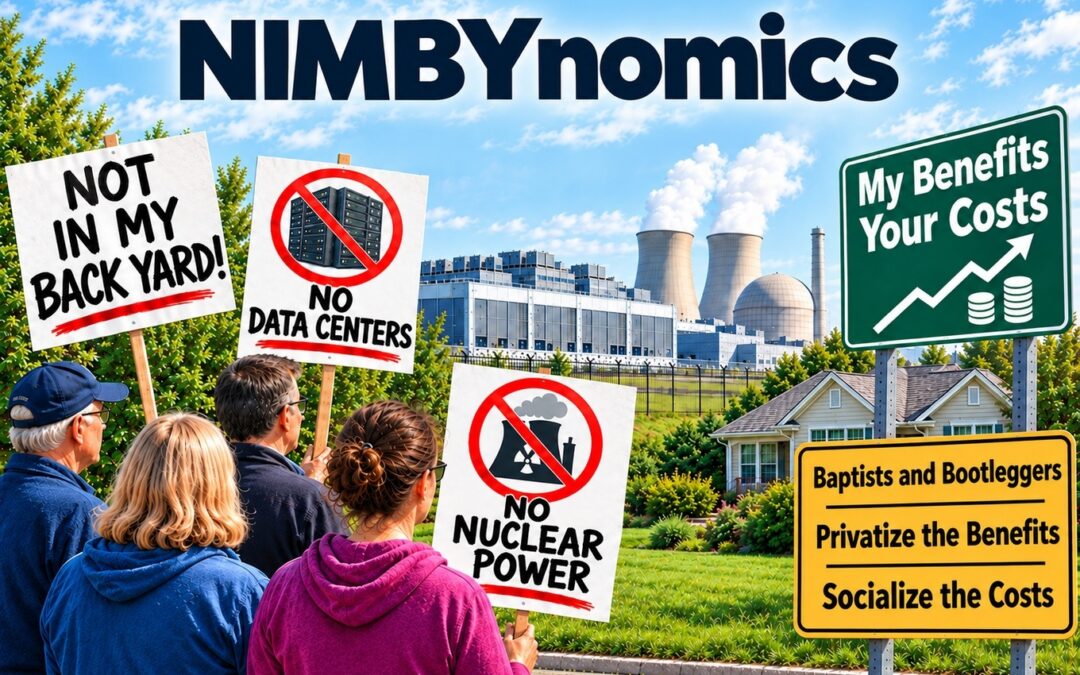
NIMBY stands for “Not In My back Yard.” This is a truly bipartisan phenomenon that helps block all sorts of economic development at the local level, and sometimes state and federal.
Blocking nuclear power and family housing are examples of typical Left NIMBYism. Blocking wind and solar power and public housing are examples of typical Right NIMBYism. Blocking data centers is the prime example of combined Left, Right and Center NIMBYism.
The key to better understanding and addressing NIMBYism is Public Choice economics. What follows next is a small sample from, and commentary on, two academic publications:
Public Choice
One important insight from Public Choice is that there is not just a civilian marketplace but also a political marketplace that both obey the laws of self-interested demand and supply.
Public Choice applies the methods of economics to the theory and practice of politics and government. Just as self-interest motivates people’s private commercial choices, it also affects their communal decisions. People also ‘economise’ as voters, lobby groups, politicians and officials, aiming to maximise the outcome they personally desire, for minimum effort. Consequently the well-developed tools of economics – such as profit and loss, price and efficiency – can be used to analyse politics too. => page 15
A second important insight is that democracy is rarely a romantic endeavour but a dirty business where private interests, of the majority or minority, often defeat the public interest.
Market transactions are voluntary: either side can walk away from the bargain if they do not like the terms on offer. But politics has to be coercive: once the collective decision has been taken, everyone must abide by it, even if they are unhappy about it. Under majority voting, not only can the majority exploit the minority [i.e. the ‘sheep and two wolves’ problem]: it is even possible for small, organised minorities [e.g. NIMBYs] to get together and impose their will on the broad, unorganised majority. => page 58
A third important insight is that special interests have greater incentives, of a monetary or psych nature, to be very active in politics. Economists call them “Bootleggers and Baptists.”
It has long been obvious that special interest groups campaign vigorously in pursuit of their own interests. The [reason] is that small groups with concentrated interests may be much more active, vocal and effective participants in collective decision-making than much larger groups with only diffused interests. Lobby groups know that their particular interests may have little traction with the general voting public or the politicians who represent them. So they often dress up their demands in ‘public interest’ language. => pages 58-59
NIMBY Problem
Although the authors make no reference to Public Choice in their paper, the issue of concentrated costs versus diffuse benefits is the economic root of the NIMBY problem.
Spatially concentrated costs [and diffuse benefits] can induce local residents—classically labeled NIMBY voters—to fight the proposed development. To the extent that NIMBYs arise in every locality, it is difficult for policymakers to find anywhere to locate projects, and this causes inefficient under-provision of social goods. Most closely associated with housing policy, NIMBYism occurs in response to a wide range of potential projects, including energy installations [e.g. data centers, hydro power and dams, nuclear power and waste, solar and wind renewables, etc.] => page 1
Hindering negotiated compensation solutions to NIMBY problems are transaction costs, or the “costs of engaging in economic calculation” based on market prices and property rights.
Transaction costs drive a wedge between developers’ willingness to pay and voters’ desire to be compensated, and this generates the NIMBY problem[.] When transaction costs are high, increasing voter compensation (from a low level) does not necessarily increase electoral support for new [development], because either way voters lose more than they gain. But when transaction costs are low, such that voters gain more than they lose from development, then increasing resident compensation leads to more project approval, which increases total social welfare. => page 6
It is an old saying that “everyone has a price.” Institutions can better align rights, costs and benefits to allow developers and NIMBYs to negotiate, and legally pay, a compensation price.
The goals of achieving socially efficient development and incorporating local resident preferences into development decisions need not be in conflict. But rather than disempowering local residents by centralizing…policy, our argument implies restructuring local institutions to reduce transaction costs for developers and thereby enable developers to compensate local residents for the costs of development. Put simply, local residents need the power not only to veto but also to approve. => page 33
NIMBYnomics Conclusion
In politics and policy, special interests often gazump the public interest. NIMBYism is one increasingly common example of this, especially in terms of data centers and nuclear power.
NIMBYs are motivated by strong incentives of concentrated costs, monetary and non-monetary. Development advocates are motivated by weaker incentives of dispersed benefits.
NIMBY “Bootleggers” can often be bought off at the right compensation price and in the right institutional circumstances. NIMBY “Baptists” sometimes and increasingly cannot.
Today, Minnesota is sliding into something worse [than NIMBY, “Not In My Backyard”]: BANANA, or “Build Absolutely Nothing Anywhere Near Anything.” It’s no longer about location. It’s about stopping the project, period, no matter where it is, how it’s run or how much it benefits Minnesota. – Pat Garofalo, “Minnesota’s slide from NIMBY to BANANA” July 20, 2026