
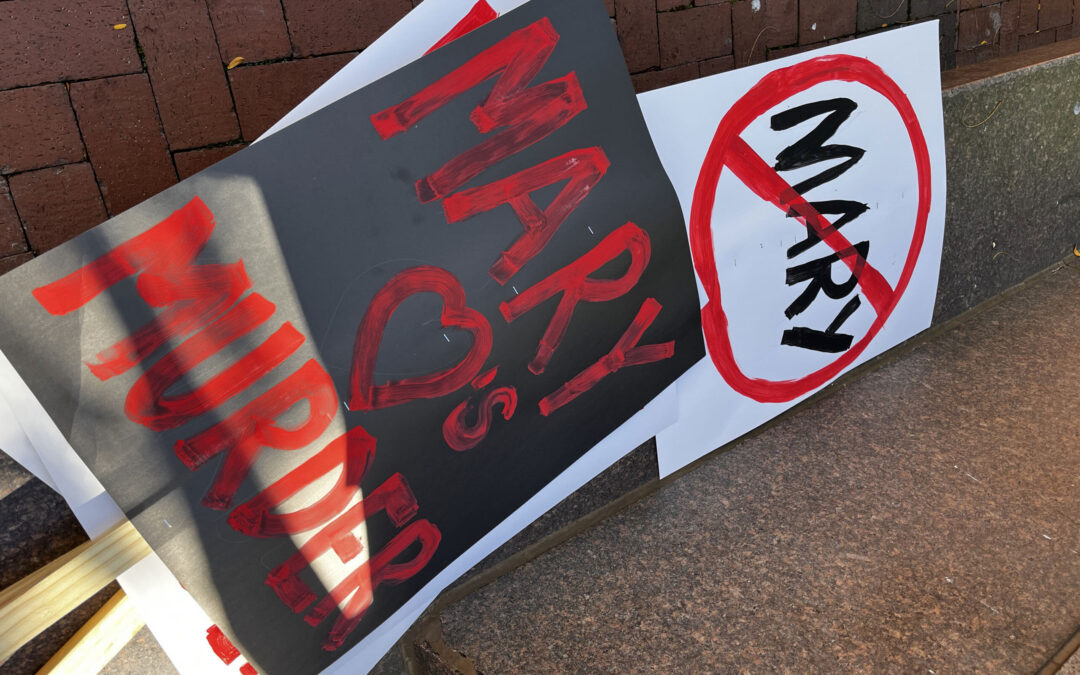
The latest controversy
This past week, Hennepin County Attorney Mary Moriarty has come under fire once again, this time for her efforts to reduce the sentence of Kemen Taylor who was found guilty of first-degree murder by a Hennepin County District Court jury in 2014.
Moriarty is using a provision of Minnesota’s prosecutor-initiated sentence adjustment statute, voted into law by the DFL led Minnesota Legislature in 2023.
Taylor is serving a life sentence for his role in the murder of a 13-year-old boy named Ray’Jon Gomez and the attempted murder of two other teens.
Gomez’s father was interviewed by the Star Tribune and noted his frustration in watching the prosecutor take a position to reduce Taylor’s sentence eleven years after Taylor was originally sentenced.
“It was all one-sided, there were no laws for the victims. It was all for the ones who were committing the crimes.”
Kevin Funchie, father of murder victim Ray’Jon Gomez
Mr. Funchie is more than justified in his frustration and anger. Moriarty’s actions represent the abdication of the critical role our prosecutors need to maintain in our adversarial system of justice.
Even the two men vying to replace Moriarty as the next Hennepin County Attorney, Anders Folk and Cedric Frazier, have both condemned Moriarty’s efforts to reduce Taylor’s sentence.
Sadly, this isn’t the first example of Moriarty undermining our adversarial system of justice.
Moriarty’s Conviction Integrity Unit
When Moriarty took over the Hennepin County Attorney’s Office in 2023, she vowed to take a novel approach with challenges to prior convictions and sentences – one in which her office joins the defense in advocating on behalf of the defendant.
A tangible step towards this new approach came in 2024, when Moriarty announced the formation of the Hennepin County Attorney’s Office Conviction Integrity Unit. Andrew Markquart, the former managing attorney for the independent Great North Innocence Project (GNIP) was hired to run the CIU.
“The Conviction Integrity Unit (“CIU”) of the Hennepin County Attorney’s Office works to investigate criminal convictions within Hennepin County where there is a plausible claim that an innocent person was convicted or some other serious miscarriage of justice occurred and, based on the findings of those investigations, pursue appropriate relief for individuals.”
Hennepin County Attorney’s Office website
In a county that had experienced a significant surge in violent crime, it seemed more important for the Hennepin County Attorney’s Office to focus its limited resources on prosecuting violent offenders, rather than seeking to exonerate previously convicted offenders. But Moriarty’s priorities matter most.
Notable cases
After three and a half years in office, the list of cases that Moriarty has sought to intervene on behalf of a defendant has grown large.
In her first year in office, she made headlines by offering outrageous plea bargains in several cases involving crimes of violence. In one, involving the execution styled killing a Brooklyn Park woman during a home invasion, Moriarty’s lenient offer led to the Attorney General’s Office stepping in a taking the case from her.
In the case of a young man with a particularly violent history, Husayn Braveheart, Moriarty manipulated the plea bargain process to allow Braveheart to go free despite having murdered a man during a carjacking, and committing several unrelated robberies, burglaries, and assaults.
In the case of Marvin Haynes, convicted of killing a flower shop owner in North Minneapolis during a robbery in 2004, Moriarty joined a petition by Haynes and the GNIP to vacate Haynes conviction nearly twenty years after a jury had found him guilty. To add insult to injury, once released, Haynes sued the state for false imprisonment and was awarded $4.5 million dollars.
Then, last August Brian Hooper filed his sixth petition for post-conviction relief hoping to get his 1998 conviction for the murder of 77-year-old Ann Prazniak overturned.
Unlike the previous five unsuccessful attempts, Hooper had advocates this time – Moriarty’s CIU and its leader Andrew Markquart.
While reviewing the case, Hooper’s accomplice, Chalaka Young wrote a letter that made it’s way to Moriarty.
Young, who was serving time in a Georgia prison for an unrelated crime, explained in the letter that newfound sobriety had led her to want to come forward with a new confession about Prazniak’s murder, some 27 years later.
In the letter, Young claimed sole responsibility for Prazniak’s murder and the attempt to dispose of her body. There were plenty of holes in Young’s story, the most significant being that she had blacked out during the actual murder and had no recollection of the details.
There are also plenty of holes in other aspects of Young’s credibility. Consider the Georgia Department of Corrections lists the following aliases associated with Young: A.K.A. BARBER, SANDRA RUTH, A.K.A. BOSTON, LISA, A.K.A. BRANNON, TINA, A.K.A. BURKS, CONNIE, A.K.A. CHAPMAN, SHARON DENICE, A.K.A. LEE, SHEILA, A.K.A. MORRIS, SANDRA RUTH, A.K.A. MORRIS, SHEILA, A.K.A. TAYLOR, LISA, A.K.A. WILLIAMS, LISA MARIE.
Nonetheless, Young was adamant that she had falsely accused Hooper 27 years ago, and that she should be believed now.
Markquart and CIU moved quickly to file a joint stipulation of facts with the GNIP, based on Young’s confession and other work the GNIP had completed to discredit the testimony of several other witnesses against Hooper.
The joint stipulation between the Hennepin County Attorney and the GNIP concluded in paragraph 123:
“Mr. Hooper is innocent in the killing of Ann Prazniak.”
The court granted Hooper’s Petition for Post Conviction Relief in September 2025, the HCAO dismissed all charges against him, and he was released from prison that day – less than two months after Young penned her letter.
Hooper is now engaged in the process of suing the state for wrongful imprisonment.
In a display of how slipshod and incestuous things can become when the prosecutor’s adversarial role becomes blurred and the courts acquiesce; a document filed in Hooper’s case speaks volumes.
The “Exoneration Compensation Order” dated January 23rd, 2026, was drafted with Marvin Hayne’s name erroneously appearing twice in place of Brian Hooper’s name. This is an obvious mistake in drafting, using an old template, but it points to a general lack of care, because after all, there’s no one paying attention to these old cases, is there? Think again.
Hooper’s exoneration also begs the question – when will Young be held responsible for Prazniak’s murder? If the HCAO considered Young’s “confession” to be trustworthy enough to exonerate Hooper, should it not consider it trustworthy enough to hold Young accountable for the murder?
None of us should hold our breath. O.J. Simpson’s claim that he would never stop searching for the “real killers” held about as much credibility as we see coming out of the Hennepin County Attorney’s Office under Moriarty.