
The Star Tribune wants you to believe that postpartum moms with the baby blues could snap at any time and kill their kids. That’s just not true.
The Minnesota Star Tribune published an opinion this week by Bernice Gyamfi that used the Lindsay Clancy murder trial as a bridge to argue the fashionable idea that pregnancy is a public health crisis. The piece notes, almost in passing, that Clancy “admitted she killed her three young children.” Then it tells you the lesson “is not about one mother. It is about all mothers.”
No, actually not. There is not a switch that might somehow be flipped (for presumably any postpartum mom) that could turn her into a homicidal Manchurian Candidate who sends her husband out on an errand so she can strangle the kids. This misogynistic take is as old as it is harmful to moms going through very real mental health struggles.
What actually happened
On January 24, 2023, in Duxbury, Massachusetts, Lindsay Clancy sent her husband out for takeout and pharmacy items. While he was gone, she took their children to the basement and strangled them with exercise bands: Cora, 5; Dawson, 3; and Callan, 8 months. She then cut herself and jumped from a second-story window. She survived, but the fall paralyzed her. Two of the children were pronounced dead that night. The baby died three days later.
The trial was about whether Massachusetts law should treat her as criminally responsible. The defense says postpartum psychosis made her do it. The prosecution says she planned it: she checked drive times, she got her husband out of the house, she chose a quiet method in a quiet part of the house, and she did it one child at a time.
This was a hard case for twelve citizens. Three children were killed by their mother. That sentence does not become optional because the killer had recently given birth. We all want to believe that a mother’s love and devotion to her children should naturally preclude her from killing them. A violation of that rocks us and causes most normal people to grasp for a moral grab bar. Unfortunately, that is causing health professionals like Gyamfi to return to some fixed notion of diagnosis to explain the horror of it all.
Women’s mental health and a history of misogyny
Postpartum depression is real. Postpartum anxiety is real. A small share of new mothers develop postpartum psychosis, a medical emergency that can include delusions and hallucinations. Those conditions deserve diagnosis, treatment, and no shame. But normalizing murder of one’s own children as a side effect of pregnancy is weird and unfortunately not new.
The word hysterectomy and the older diagnosis hysteria share the same Greek root. For more than two millennia, physicians have blamed the uterus for making women insane and irrational.
Pregnancy and gynecologic conditions have caused the misdiagnosis of mental health struggles and caused horrible harm to women and girls. “The presumed relationship between the female reproductive organs and states of insanity casts a dark shadow over the history of medicine.” Researcher Thomas Pollack writes, concluding “It perhaps reached its grim apotheosis in the late 1800s, when gynecologists conducted hysterectomies, oophorectomies (removal of ovaries), and clitoridectomies (female genital mutilation) for all manner of nervous diseases.”
As late as the mid-1970s, the US federal government through the Indian Health Service sterilized thousands of Native women under consent practices that frequently failed federal rules; independent estimates put that at roughly one-quarter to one-half of Native women of childbearing age in that period, with hysterectomy one of the common methods used.
This Star Tribune editorial and countless others like it are continuing this historical injury by actually harming the very women they seek to help, as they engage in age-old tropes around women’s mental health. Postpartum mental health is an important part of comprehensive care for moms and babies. But this author and others are not helping. If they truly want to save kids from being murdered, the data clearly show they are looking in the wrong place.
Usually, it’s the dad
According to a longitudinal study by the Journal of the American Medical Association, mothers are less than half as likely as their male partner to kill their children.
| Age group | Biological father | Biological mother | Mother’s male companion (boyfriend/stepfather) |
| Infants (<1) | 47.7% | 27.3% | 11.3% |
| 1–5 years | 24.0% | 21.9% | 29.6% |
| 6–10 years | 34.9% | 20.5% | 13.5% |
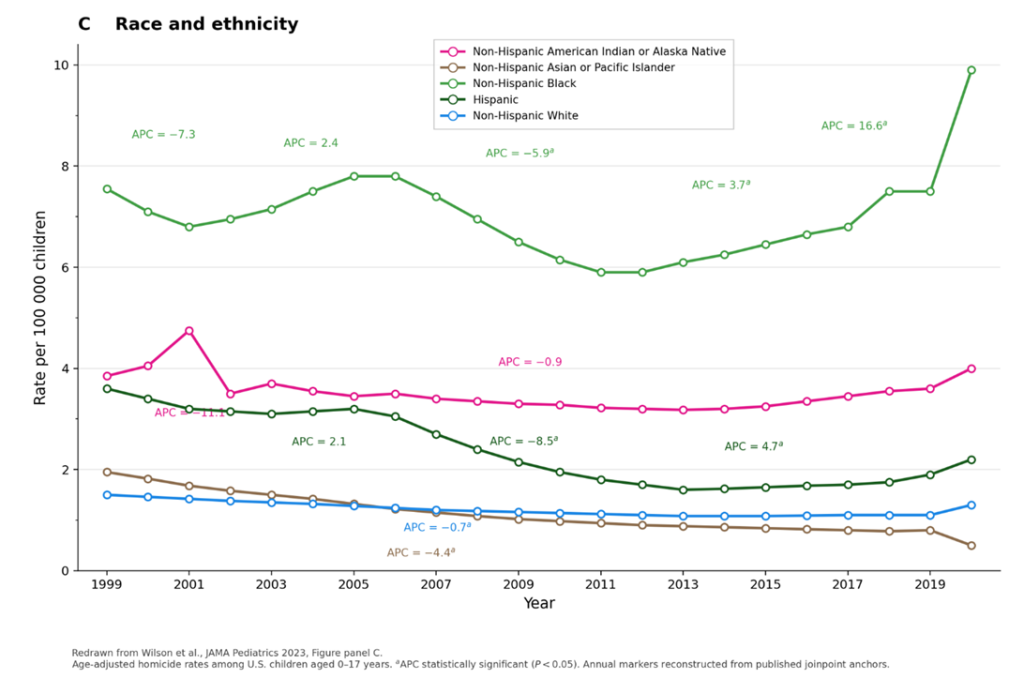
Homicide rates for Asian or Pacific Islander and White children have steadily declined since 1999, whereas rates for Black and Hispanic children have steadily increased since 2012 and 2014, respectively.
Not only are men more than twice as likely to kill kids as moms, but that boys are more likely to be killed than girls, and black boys are more than four times more likely to be killed than white boys.

The victims keep getting edited out
If this atrocity is mainly a failure of services, then the person who committed it is mainly a maternity patient, and the people she killed are mainly a policy argument. That is convenient for people who write about systems. It is an insult to the dead and the moms who truly struggle with mental health struggles during and after pregnancy.
Clancy was not an abandoned teenager with no doctor. She was a labor-and-delivery nurse at Massachusetts General Hospital. She had seen psychiatrists, nurse practitioners, therapists, an emergency room, a day program, and an inpatient stay at McLean. She was on a stack of medications. Her family was helping with childcare. Nineteen days after discharge from a psychiatric hospital, she strangled her kids. You can believe the treatment was imperfect — her own civil lawsuit says it was — and still refuse the next leap: that her care team or her pregnancy itself was to blame.
The Star Tribune did not have to import a Massachusetts murder trial to remind Minnesota that new mothers need care. We already know that. We also know something the paper is less eager to say: compassion that cannot tell the difference between illness and homicide is not compassion.
Pregnancy has side effects. Murder is not one of them. It is very likely that mental illness contributed to the deaths of these poor kids. How much? That’s what juries must conclude.
Cora Clancy was five. Dawson was three. Callan was eight months old. They are the story. Everything else is what people say when they would rather talk about anything else.