

As a new school year gets underway, parents have some homework of their own to get done: knowing the rights they have within the public education system and how to exercise them so they can play an active role in their child’s education.
American Experiment’s Minnesota Parent Toolkit is a helpful resource that explains some of the legal rights parents have to advocate for their children. It even includes ready-to-use forms parents can submit to manage the boundaries of their children’s instruction.
Below are a handful of rights that parents should keep top-of-mind, remembering that they are state law for a reason.
Curriculum review & opt-out
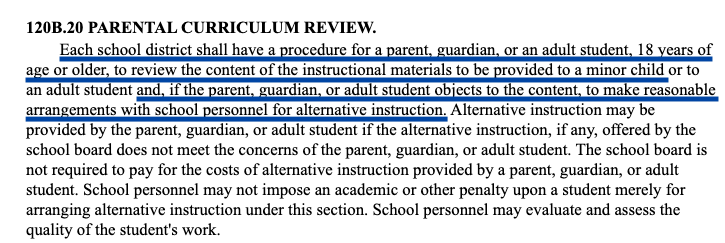
Under Minnesota Statute 120B.20, a school district must have a procedure in place for parents to review the content of the instructional materials provided to their children and, if the parent objects to the content, make reasonable arrangements with school personnel for alternative instruction. Alternative instruction may be provided by the parent if the alternative instruction offered by the school board does not meet the concerns of the parent. The student cannot be penalized for using alternative instructional materials.
This state law complements a recent U.S. Supreme Court decision (Mahmoud v. Taylor), which found that schools cannot deny parents the ability to opt their children out of instruction that conflicts with their religious beliefs.
Using this form from the Pacific Justice Institute, parents can note the instructional content they would like their child exempted from — including sex education, LGBTQ+ content and materials, and gender identity and expression instruction.
Serve on a District Advisory Committee
A school board must establish an advisory committee to ensure active community participation in all phases of planning and improving instruction and curriculum affecting state and district academic standards. Whenever possible, parents and other community residents must comprise at least 2/3 of advisory committee members. Interested parents should ask their school board for more information about serving in this capacity.

Reconsideration of library materials
School districts must have a policy in place for library materials to be “challenged” and “reconsidered.” Usually, these district policies are numbered in the 600 range.
While under state law a public library “must not ban, remove, or otherwise restrict access to a book or other material based solely on its viewpoint or the messages, ideas, or opinions it conveys,” the library does have the authority to remove or restrict access to books based on “legitimate pedagogical concerns” including the “appropriateness of potentially sensitive topics for the library’s intended audience.” Parents also still have their opt-out rights under Minnesota Statute 120B.20.
From Minnesota Statute 124D.991: “A school library or school library media center must have the following characteristics: … has a collection development plan that includes but is not limited to materials selection and deselection, a challenged materials procedure…”
And from Minnesota Statute 134.51: “A governing body of a public library must adopt a policy that establishes procedures for selection of, challenges to, and reconsideration of library materials.”
Survey opt-out
Parents have the right to opt their child out of surveys and questionnaires that ask students about their political beliefs, mental problems or challenges, sexual behavior or attitudes, illegal or self-incriminating behavior, critical appraisals of people with close family relationships, relationships with lawyers, doctors and ministers, religious beliefs or practices, or income level (unless asked to determine participation eligibility).
These eight areas are considered protected information under the Protection of Pupil Rights Amendment (PPRA) and as such, schools that receive federal funding are required by federal law to inform parents of any survey or questionnaire that gathers this information and to obtain their prior consent.
Additionally, parents have the right to inspect, upon request, a survey created by an outside entity that a school district wants to distribute or administer, along with any supplemental material (such as a teacher’s manual) that comes with the survey. Students can also tell their teacher they do not wish to take non-academic in-class surveys, questionnaires, or emotional “check-ins.”
Parents should ask their principals what the opt-out process is in their district. Many have district-specific opt-out forms that simply need to be signed at the beginning of the school year and turned in to school officials.
Special education rights
Under Chapter 125A of Minnesota Statutes and the federal Individuals with Disabilities Education Act (IDEA) law, parents of children with disabilities have several specific procedural rights. A district must get a parent’s written, informed consent before it evaluates their child for services, and again before it starts providing those services. If the parent doesn’t agree with what’s being proposed, they can request a conciliation conference, mediation, a facilitated Individualized Education Program (IEP) meeting, or a formal due process hearing. If a parent believes the district has violated special education laws, a written complaint can be filed with the Minnesota Department of Education.
Released time for religious instruction
Minnesota Statute 120A.22 allows a child attending a public school to be excused from school with written parental consent for a maximum of three hours per week to receive “instruction conducted by a Tribal spiritual or cultural advisor, or a school for religious instruction conducted and maintained by a church, or association of churches, or any Sunday school association incorporated under the laws of this state, or any auxiliary thereof.” The instruction must take place off school grounds and at no expense to the public (no government spending of state resources/taxpayer funds allowed).
Adopting a local policy on a released time program is left to the discretion of each local school board. (Separate from released time policy, districts have policies on religion in schools, which lay out the rights of students to express personal religious beliefs or views, wear religious clothing, etc. and the responsibility of the district to ensure the study of religious materials, customs, beliefs, and holidays neither advances nor inhibits religion.)
Attend school board meetings
Under Minnesota’s Open Meeting Law (Chapter 13D of Minnesota Statutes), all meetings of a school board (including committee and subcommittee meetings) must be open to the public. School boards must also provide proper notice of their meetings in advance so parents and other community members know when and where board business will be conducted. If a board votes to close a meeting, it must state on the record the specific grounds permitting the meeting to be closed and describe the subject to be discussed.
Attending school board meetings can be a way for parents to learn more about what instructional materials are being purchased or discussed.
Submit public data requests
In accordance with Chapter 13 of Minnesota Statutes, the Minnesota Government Data Practices Act gives everyone the right to inspect and have copies of public data. Public data include all the data a school district keeps unless there is a state or federal law that classifies the data in some other way. Upon request, a school district must provide public data to whoever asks, regardless of who is asking or why. The district cannot require the person submitting the data request to identify him or herself or explain the reason for the data request.
Requests for public data can include literature and curriculum materials, school policies, and other media or communication from or through political/advocacy groups, to name a few.
Most school districts’ data request policies require the requests to be in writing and reference the Minnesota Government Data Practices Act (Chapter 13). The school district is not required to create or collect new data in response to a data request.
Most school districts also have a data practices compliance official parents can submit their request to. Search “data request” on a district website to locate submission steps.
Between this and the right to attend school board meetings, parents have two separate ways to find out what materials a district is buying or considering.
___________
Parents, have a great school year, and remember, knowing your rights and exercising them helps you better partner with teachers and school administrators to make sure your child is supported and successful!