
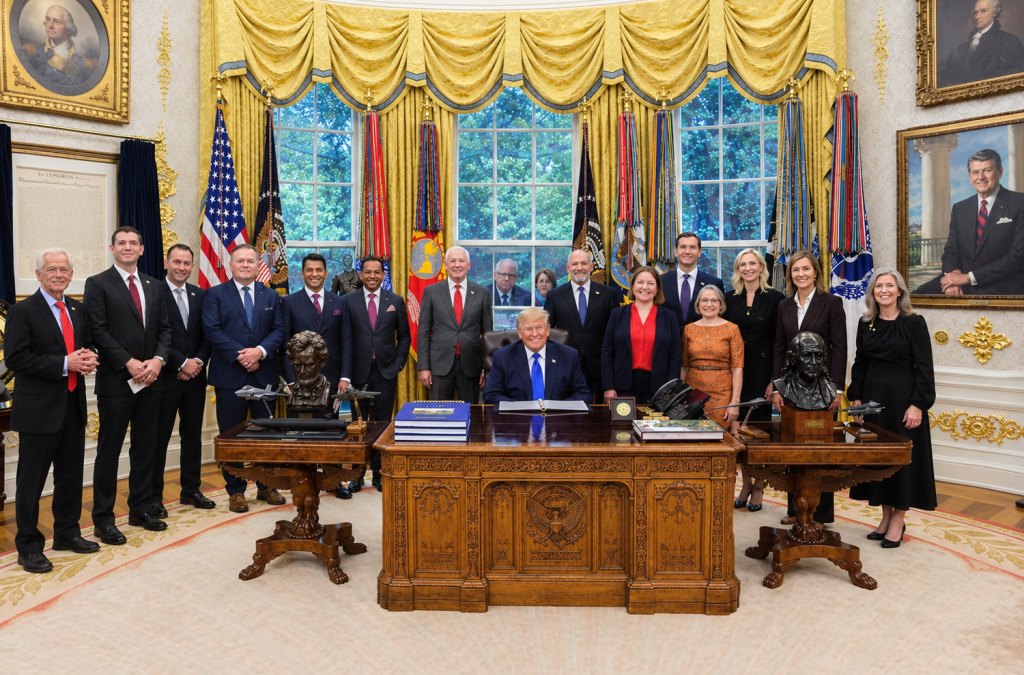
President Donald J. Trump announced on September 30, 2026 that the “Largest-Ever Steel Plant [is] Coming to Iowa.” This is Iowa. Not Minnesota, where the iron ore is mined by the same company of Mesabi Metallics. Although not asserted, MN energy affordability was key.
Mesabi announced today at the White House an $18 billion investment to build a fully integrated steel company, uniting its iron ore mine on Minnesota’s Mesabi Iron Range with a new steel complex in Iowa. Mesabi will invest $15 billion to build the Iowa facility, in addition to the $3 billion being spent to complete the iron ore mine in Minnesota. Creating the largest single investment in a steel complex in American history[.]
Mesabi’s news release appears to suggest that energy affordability was a major consideration in choosing IA over MN:
- “…technology that will significantly lower energy usage and reduce emissions.
- “…reduces the energy required…, improving the efficiency and productivity of the steelmaking process.”
- “…reducing energy use and emissions compared to traditional blast furnaces.”
What did not get mentioned by Mesabi, or the White House, was IA vs MN on business climate, loans, regulations, subsidies or taxes, although these might have also been factors. According to the World Steel Association electricity input costs can be as high as 40%.
Ranks
Chart 1 below shows state rankings out of 50 for MN vs IA, not including Washington DC nor the US as a whole, for average electricity rates in cents per kilowatt-hour (¢/kWh) for total customers combined (i.e. residential, commercial and industrial). Rank 1 is best and rank 50 worst. Chart 2 further below shows industrial only, over the same time period of 1970 to 2026. Highlights include:
- Chart 1: MN total ranking improves from 36 in 1970 to the state’s best of 9 in 1988-1990, then goes backwards to 13 by 2003, and deteriorates to the state’s worst of 37 in 2021, with some improvement to 30 so far in 2026. IA passes by MN, going from 20 in 2006 to 11 in 2007, and eventually to 7 in 2026 year to date.
- Chart 2: From 1988 onwards, IA industrial ranks better than MN, going from 13 that year to 9 in 2026, whilst MN went from 15 to 33, noting that MN’s worst was 39 in 2021-2022.
Chart 1

Chart 2

Rates
Once again the take-off year for electricity rates in MN, and to a lesser extent IA, is 2002. This can be seen below for total customers in Chart 3, and for industrial in Chart 4 further below. Highlights include:
- Chart 3: MN total electricity rates inflate 125%, between 2002 and 2026, from 5.80 to 13.03 (¢/kWh), whilst IA increase 67% from 6.01 to 10.03 (¢/kWh).
- Chart 4: MN industrial electricity rates swell 140%, between 2002 and 2026, from 4.07 to 9.75 (¢/kWh), whilst IA rise 82% from 4.06 to 7.38 (¢/kWh).
- Rates volatility between 2002 to 2026, as measured by Relative Standard Deviation, for MN total and industrial were 23.1% and 23.3%, compared to IA’s 14.9% and 17.4%.
Chart 3

Chart 4

Reliability
The three traditional measures of reliability for electricity distribution are SAIFI, SAIDI and CAIDI, which can be proxies for overall reliability for franchise monopolies, like in MN and IA. Highlights for SAIFI in Chart 5 below include:
- Between 2014 and 2024, MN SAIFI increased 24.9%, was 10.3% volatile and 1.06 on average. IA SAIFI decreased -2.6%, was 15.8% volatile and 1.08 on average.
- If one removes the “2020 Midwest derecho” storm event, then MN SAIFI volatility increases slightly from 10.3% to 10.8%, whilst IA’s dramatically falls from 15.8% to 10.6%.
Chart 5

Conclusion
One mainstream media report said: “Power can be a major cost for steel producers, and commercial electricity prices in Iowa are marginally lower than in Minnesota.” However:
- “Power” is, and not just “can be a major cost.”
- “Electricity prices” are not “commercial” but actually “industrial.”
- “Electricity prices” in Iowa are not “marginally lower” than Minnesota, but are whoppingly lower by 32%!
Not only should the MN PUC “look in the mirror” on energy affordability, so to should the MN Uniparty, which has encouraged (since 2001) and mandated (since 2007) electricity unaffordability, and state-wide de-industrialization, under the guise of saving the planet.
