
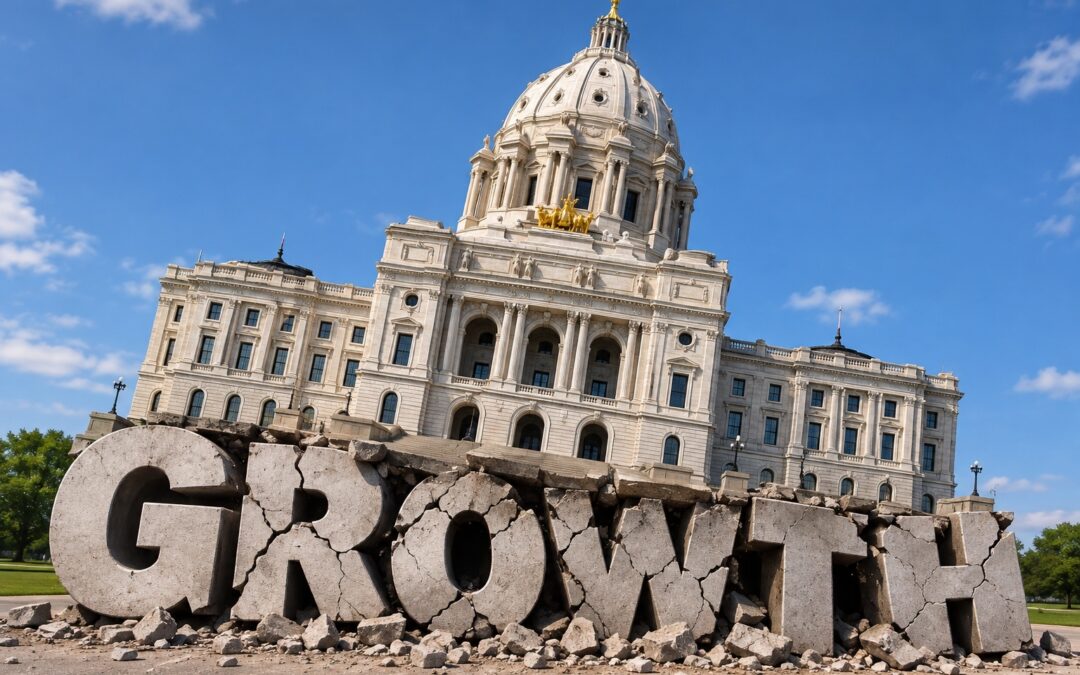
Last week, gubernatorial candidates Sen. Amy Klobuchar and Rep. Lisa Demuth spoke at the Economic Club of Minnesota. Both, according to Twin Cities Business, “acknowledged that Minnesota’s economic growth rate is below the national average, and [that] it’s up to the next governor to use a variety of approaches to make Minnesota more hospitable for existing businesses and potential new companies.”
Twin Cities Business went on to report that:
Klobuchar stressed that she would “cut through the red tape” and “transform our state government to a place where people want to come to do business” She said she’d look at what Democratic and Republican governors were doing in other states for “getting things done faster, quicker, smarter.”
She talked about accelerating the permitting process for businesses and “consolidating a number of our state review processes.”
This fits with Klobuchar’s overall theme, which is that Minnesota is a “mess” after 16 years of DFL governance so she needs to be elected to fix it. Taken on their own merits, the ideas she expounded are sound enough, and in line with the recommendations in our recent report “Supplying Hope and Demanding (Real) Affordability: An agenda for Minnesota’s future.”
But the report continues:
“I don’t believe we should raise taxes,” Klobuchar said. “I believe, if we can, we should reduce taxes.”
Kare 11‘s report confirms that:
In a break from the last two Democratic administrations in Minnesota, Klobuchar said she opposes raising taxes and would work to reduce taxes if possible.
Again, sound enough, but in complete contradiction with the platform her DFL colleagues are running on for the legislature.
Back in July, the Minnesota House reported, “DFL legislators from the Minnesota House and Senate unveiled the Minnesota Values Project Policy Agenda 2027. The agenda is the result of input from Minnesotans across the state and will serve as the guiding vision for lawmakers when they return to the Capitol in 2027.”
The agenda is 16 pages of fresh spending commitments, some large, and all on top of a budget which is already in deficit. It promises:
“Establish Universal Primary Care, because when everyone can go to the doctor for a check-up, you avoid costly emergencies in the future.
Expand access to public health care options like Minnesota Care, allowing more Minnesotans to have health insurance outside of the profit-driven market.
Low or no-cost child care access for every Minnesota family, as universal and in as many towns in the state as we can make it. This will mean more investment in public pre-K, Head Start, and community-based childcare in all corners of the state.”
And on and on. Its section on education, for example, is all about spending more money; there isn’t a single, solitary mention of actually boosting the state’s slithering educational outcomes.
All this new spending will be vastly expensive. By one estimate, providing free, universal childcare will cost the state government $10 billion in each biennium. Considering that the state is spending $71 billion in the current biennium, that is a 14% hike in state government spending before you even think about giving everyone free primary care and more access to Minnesota Care. We are looking at tens of billions of dollars in new spending, on top of budget deficits already totaling billions of dollars, just from these three proposals.
Next year, Minnesota’s state government is forecast to spend $1.6 billion more than it collects in revenue. On top of that, the DFL House and Senate candidates propose at least $5 billion annually of new spending. To cover just that $6.6 billion commitment, the state’s revenues would have to increase by that amount, or 19.5%, a staggering hike in spending that can only be paid for with massive tax hikes on middle class Minnesotans — hikes of exactly the kind Sen. Klobuchar says she wants to avoid.
Will the real DFL platform please stand up?