
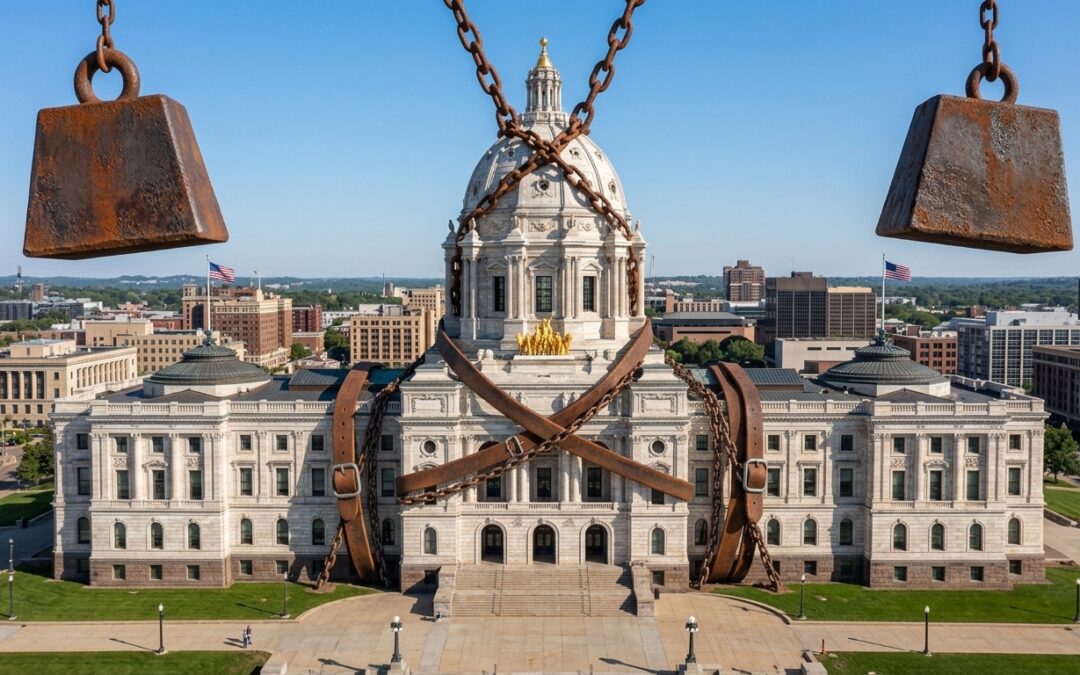
This November, voters will decide whether the state should draw more money from the Permanent School Fund to increase per-pupil aid to schools.
In addition to the general fund— the state’s primary operating fund — Minnesota public schools have historically received funding from a trust fund. The trust, as Catrin Wigfall explains, is funded by revenue from mining and timber production on lands federally granted to the state in 1858.
Under the Minnesota Constitution, the revenue is deposited into the Permanent School Fund (PSF), a constitutional trust that provides annual support for K-12 public education. As of March 2025, the fund is valued at $2.3 billion.
Schools receive distributions from the fund’s investment income (mainly interest and dividends). Annual distributions have generally been around 2 to 2.5 percent of the fund’s value. The principal itself can’t be spent, as the Minnesota Constitution requires it remain “perpetual and inviolate forever.” If the fund experiences realized investment losses, those losses are recovered over time through a statutory smoothing process that can affect future income available for distribution. This is one reason payments can fluctuate from year to year.
For FY 2025, the interest and dividends produced a record $58 million for the state’s 329 public school districts and 181 charter schools, or about 0.4 percent of E-12 education’s biennial budget. Statewide, that averaged out to about $68 per student. Anoka-Hennepin, the largest district, collected $2.6 million. Minneapolis got $2 million.
If the constitutional amendment passes, annual distributions will rise to 4.5 percent of the fund’s market valuation.
So far, discussions around the amendment have largely ignored the state’s deteriorating fiscal outlook. This is likely because, as currently structured, the trust is entirely separate from the general fund and operates as “extra” funding for public schools.
Minnesota’s general fund budget, however, has operated on a structural deficit each year since 2024. E-12 education and Health and Human Services (HHS) are the state’s two largest expenditures — taking up over 70 percent of the budget — and the two areas likely to deliver the necessary savings to close the deficit.
The Permanent School Fund could serve as a buffer for general fund spending cuts in E-12 Education in 2027. But this will require that the trust remains solvent long-term — a difficult task to accomplish if the constitutional amendment passes.
For one, raising the annual distribution to 4.5 percent of the fund’s valuation could eat into the principal, draining the trust over time. More immediately, it means no reserve option just as lawmakers head into what will likely be a brutal 2027 budget session.
Worst of all, the allure of “extra” funds might stall necessary spending reforms required to achieve long-term fiscal stability for both schools and the state.