
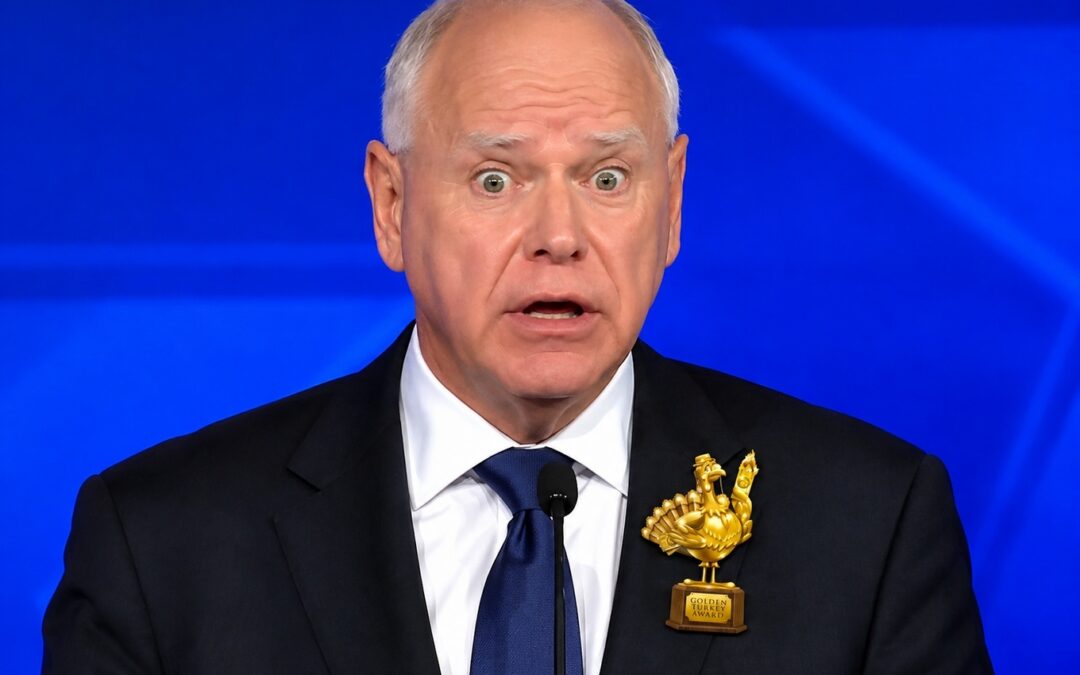
Tim Walz earned an “F” grade, and a “50” place ranking, in the new edition of “Freedom in the 50 States,” released by the Cato Institute on October 22, 2026. This was in “Tech and Consumer Freedom,” which is based on four variables including “Retail Electricity Choice.”
The report ranks all 50 states, and for the first time this year all 50 governors, “on their support for and protection of both economic freedom and personal freedom.” In addition to ranks from 50 to 1, there are percentages out of 100%, scores of 0 to 10, and grades of F to A.
Economic Freedom includes: Fiscal Burden; Housing Freedom; Occupational Freedom; as well as Tech and Consumer Freedom. Personal Freedom includes: Education Freedom; Firearm Freedom; Freedom from Law Enforcement Overreach; Freedom of Speech and Association; Medical Freedom; as well as Recreational Freedom.
Governor Ranks & Grades
Seven governors receive an F (in rank order): Vermont’s Phil Scott (R), Oregon’s Tina Kotek (D), Arkansas’s Sarah Huckabee Sanders (R), Minnesota’s Tim Walz (D), Indiana’s Mike Braun (R), Idaho’s Brad Little (R), and South Carolina’s Henry McMaster (R).
In the table of rankings, Tim Walz (D-MN) was fourth from last place, with a score out of a potential 10.00 of −0.52. He was tied for 50th place with three other governors of Mike Braun (R-IN) at −1.26, Brad Little (R-ID) at −2.00, and Henry McMaster (R-SC) also at −2.00.
State Ranks & Grades
Five states receive an A. Texas has the highest score because it has…the most robust residential electricity choice in the nation, and a regulatory sandbox for some industries, including AI. Six states receive an F for the opposite reason [including] Minnesota [which] has [no] electricity choice or a regulatory sandbox.
This state is dominated by government mandated renewables, along with a PUC-Xcel co-dependency, which has sunk MN electricity affordability from 14th in 2001 to 30th in 2026.
Retail Electricity Choice
Customers fare better when electricity sellers compete for their business. In most states, consumers are forced to buy electricity from one monopoly provider. In states with retail electricity choice, by contrast, households can buy power from two or more competing retailers with different prices and plans, even when the local utility maintains the distribution infrastructure.
Seventeen states have, full or partial, retail electricity choice, including 3 in the Midwest. Many countries, including Australia, have also allowed for electricity generation competition.
Tech & Consumer Freedom
[A] state regulation that encourages a developer to hold back a feature, avoid a market, or shut down a service trickles down to consumers and can result in a less capable product or service, a higher price for it, or no access to it at all.
The primary outcome from, and perhaps goal of, the “Regulatory Compact,” between the PUC and public utilities like Xcel, is no competition and, thus, low innovation and high prices.
State Regulatory Sandboxes
A state regulatory sandbox [SRS] allows businesses to develop and test new products, services, or business models under state-approved exemptions from specific regulations. States offer sandboxes because rules written for established industries can unintentionally stifle innovation or deter certain technology businesses from locating in a state or from deploying or offering their services there.
In 2022, MN had nearly 100,000 regulations. The regs for utilities sum to 395 pages across 11 chapters, and unlike a SRS, these: intentionally stifle innovation in electricity; and deter certain technology businesses from locating here, such as data centers and steel mills.
Golden Turkey Awards
The competition to find the most bird-brained examples of waste in state government is back and getting ready to kick off. Past winners of this ignominious award include Governor Walz’s $430,000 legal bill, the new state flag design, the state office building, Feeding Our Future, Tim Walz’s morgue, a gold-plated rest stop and a lonely bus stop that never welcomed any buses. Not to mention the lifetime achievement award for Southwest Light Rail Transit.
Which wasteful project will earn the 2026 Golden Turkey? You tell us!
Tim Walz has twice won the annual Golden Turkey Award in his two terms as Minnesota governor, and is certainly worthy of a ‘hat trick’ before his tenure ends on January 4, 2027.
The energy affordability accomplishments of Governor Walz, along side his state Attorney General Keith Ellison, from 2019 to 2026 include:
- Residential electricity rates inflation of 25%, from 13.04 to 16.25 ¢/kWh.
- Commercial electricity rates inflation of 21%, from 10.34 to 12.47 ¢/kWh.
- Industrial electricity rates inflation of 30%, from 7.53 to 9.75 ¢/kWh.
- Total electricity rates inflation of 26%, from 10.33 to 13.03 ¢/kWh.
AG Ellison is also a worthy nominee, given his legislative role in “furthering the interests of residential and small business utility consumers…involving utility rates” plus his campaign motto of “it’s my job as…the People’s Lawyer to help Minnesotans afford their lives.”
