
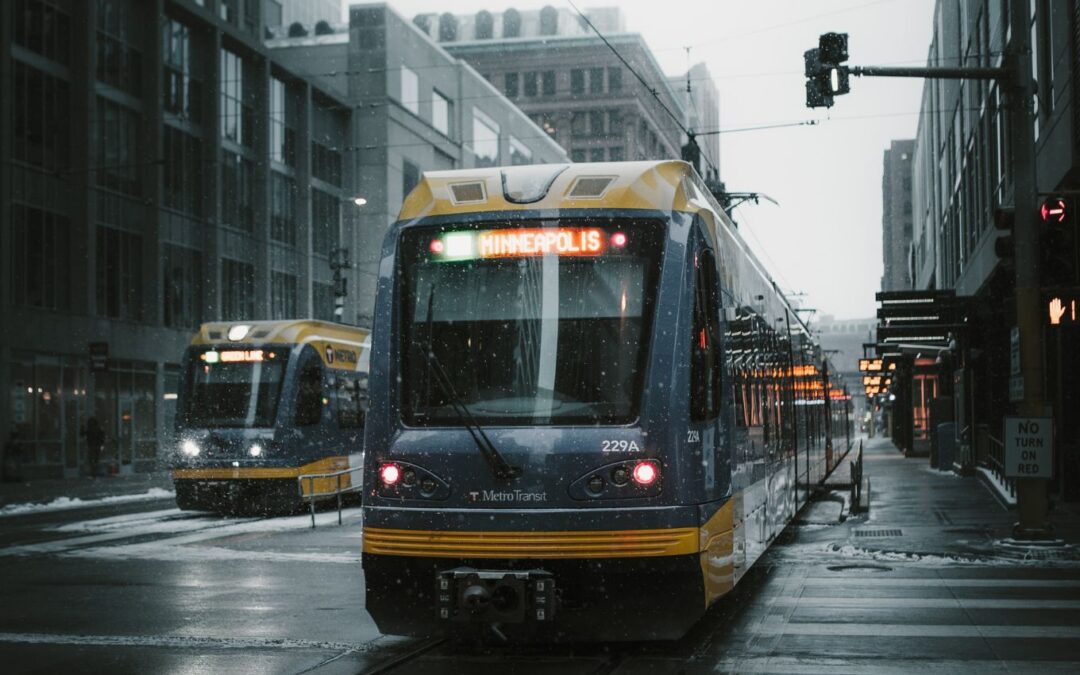
The murder
During the late evening of October 3rd, Jaquan Edwards, 30, entered the light rail train at US Bank Stadium heading for St. Paul. Edwards was alone, wore a “covid mask” which hid his identity, and was carrying a concealed firearm.
A few minutes later another man entered the same train car at the East Bank station and sat in a seat across from Edwards. Surveillance video indicated that the two exchanged some dialog. As the train travelled between the Stadium Village and Prospect Park stops near the University of Minnesota, Edwards pulled out a gun and fired three shots at the other man. Edwards exited at Prospect Park and walked away on University Avenue, discarding his mask along the way.
The train stopped at the Westgate stop where police arrived and located the victim. The victim was unconscious and had a gunshot to his neck. Lifesaving efforts were attempted but the man died at the scene.
The murder appeared to be a random violent act between strangers. Edwards’ identity was obscured and there were no eyewitnesses mentioned in available court documents. Cases involving these elements are often referred to informally as a “whodunit.”
The investigation
The Minneapolis Police Homicide Unit began working on the case immediately – always critical in solving murder cases where evidence can disappear quickly.
While reviewing surveillance video of the murder suspect’s movements associated with the light rail, detectives observed him spitting voluminously onto the US Bank Stadium train platform before entering the train. Crime scene technicians located the spital at the train stop and collected samples which provided a male DNA profile.
Additional surveillance video review and “To-Go” card useage led detectives to video footage of the murder suspect riding an MTC bus in Maplewood, Mn. Detectives conducted canvassing of businesses in that area and located video of the suspect entering a HyVee grocery store and an Advance Auto Parts store. Detectives showed the surveillance video to employees and learned that the suspect was an employee of the auto parts store. Employees identified him as Jaquan Edwards.
Detectives learned that in July 2026, the White Bear Lake Police Department had stopped Edwards for a traffic infraction while he drove alone in his mother’s car. During that stop, the White Bear Lake police officer noted that Edwards was smoking a wood tipped cigar. Detectives conducted a search of discarded garbage from Edward’s mother’s Maplewood residence and recovered six discarded wooden cigar mouthpieces. The DNA recovered from those mouthpieces matched the DNA from the spital the murder suspect had left on the light rail platform just before the murder.
It’s unclear for available court records whether the gun used by Edwards has been recovered or if ballistic evidence testing has been conducted.
On October 28th, the Hennepin County Attorney’s Office issued a complaint and warrant charging Edwards with one court of murder in the second degree, and asking for $1 million in bail.
Hennepin County jail records indicate the Minneapolis Police arrested Edwards on October 30th in St. Paul. Edwards made an initial court appearance on November 2nd and has an evidentiary hearing scheduled for December 1st. Edwards remains in the custody of the Hennepin County Sheriff’s Office.
The takeaway
It wasn’t too many years ago that a murder like this may have gone unsolved. The investigative tenacity in this case was excellent – and in 2026 that tenacity is often rewarded by voluminous video and electronic evidence, advances in DNA technology, and advances in ballistic comparison technology. Thankfully, because of these advances, the case against Edwards appears strong.
This outcome supports the use of video surveillance in public spaces.
The outcome also supports the need for proper police staffing. The Minneapolis Police Department remains understaffed, some six years after its own city council attempted to “dismantle” the police department. While the outcome here was positive, a police department of 600 officers cannot be expected to properly service a city the size of Minneapolis.
When the deterrent effect of a highly visible police presence is missing and investigative follow up is severely compromised because of a lack of manpower, citizens ultimately pay the price.