
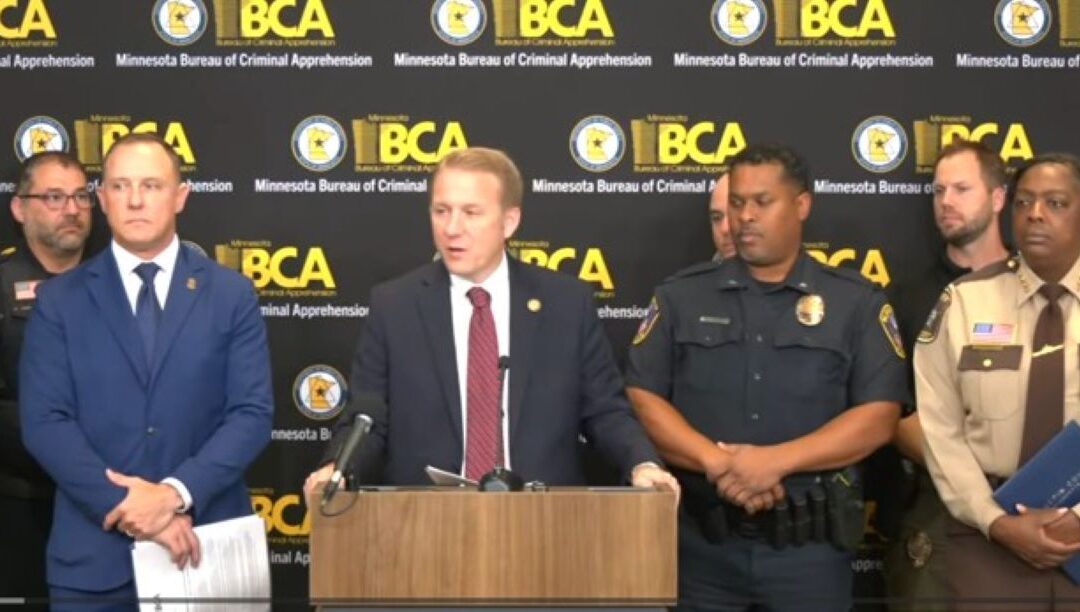
Representatives from forty-six (46) local, state, and federal law enforcement agencies and task forces gathered at the Minnesota Bureau of Criminal Apprehension (BCA) yesterday for a press conference to update Minnesotans on the law enforcement response to recent Somali youth violence in the metro area.
The press conference was led by BCA Superintendent Drew Evans who was joined at the podium by the heads of the local FBI and ATF offices as well as Hennepin County Sheriff Dawanna Witt, Bloomington Police Chief Booker Hodges, Edina Police Chief Todd Milburn and others. In all, the group represented law enforcement from five metro counties.
Enhancing existing efforts
The message delivered was that law enforcement leaders had gathered last week to agree on how they would collectively respond to the recent violence. The decision was made to build on existing investigative efforts and enhance the information sharing between those efforts, rather than create an all new “regional task force,” which had been considered. A comprehensive summary of the plan and agreements can be found here.
That decision is solid. The infrastructure and agreements are already in place with existing efforts that include multiple county level violent crime enforcement teams, gun crime investigative teams, gang units, and federal violent crime task forces managed by the ATF and FBI. This will allow those efforts to focus on the Somali youth violence issue immediately, rather than a larger effort being delayed as it tries to get off the ground.
Whether it’s enhancing existing efforts or ultimately creating a new effort, law enforcement has to become more proactive in addressing the Somali youth violence problem. It’s been common knowledge for years that large groups of Somali youth have taken over the Stone Arch Bridge or portions of Dinkytown by the University of Minnesota on weekend nights – and the level of disorder and violence that has arisen is completely unacceptable. Those events need to be blunted before the violence erupts.
Seamless information sharing is the key
The key to this collaboration is ensuring seamless information sharing between the existing efforts. This will be accomplished through improved information sharing agreements between area intelligence centers, focusing on connecting firearm violence occurring across multiple jurisdictions. Another key to this effort is in the listening sessions many of the law enforcement agencies have held with their local Somali community members – ensuring that lines of communication and trust are built, not destroyed. A final key component of the effort is the utilization of county based “quick reaction” teams of uniformed and investigative officers that will rally on short notice as needed.
Sheriff Fletcher – out of the denial phase
Ramsey County Sheriff Bob Fletcher spoke with reporters following the press conference. During that session, Sheriff Fletcher made a few important comments. First, he shared that the Somali violence is relatively new, and the cliques and gangs have not yet transitioned into traditional gang activity focused on drug and contraband distribution. As such, law enforcement is in a good position to positively affect the trajectory of these youth, if they act soon. Second, he noted that the community is now “out of the denial phase,” when it comes to the problem of Somali youth violence. With that reality Sheriff Fletcher noted that law enforcement can begin “moving into the solution phase.”
While some law enforcement leaders may disagree with Sheriff Fletcher at times, it is undeniable that he was out ahead of this problem and that his calling out of the Somali violence a year ago was a significant driver in the resolve we now see across the law enforcement community to address the issue.
Concerns by omission
Unfortunately, some concerns arose during the press conference by omission. There was a notable lack of information shared regarding the roles and commitments of county and federal prosecutors in this effort. The prosecutorial follow-through will be critical in sending an effective deterrent message to those emboldened enough to carry out high profile shootings that endanger us all and erode our sense of safety.
We must demand more of our prosecutors than we witnessed in the charges and bail set in the recent Eden Prairie High School homecoming football game double shooting. In that case the shooter was charged with 2nd degree assault rather than attempted murder, and the $100,000 bail allowed for the defendant to bond out (usually at just 10%) within a day of his arrest. That fails to deter, and arguably emboldens, others who are intent on carrying out violence.