
Labor Day 2026 is almost upon us. It takes place on the first Monday of September each year. This year that will be on the 7th. This federal holiday since 1894, according to the History Channel, “pays tribute to the contributions and achievements of American workers.”
This should also be a time to celebrate energy, which is defined by the Energy Information Administration (EIA), “as the ability to do work.” The EIA adds that “there are many forms of energy,” including “electrical,” noting “electricity use has dramatically changed daily life.”
I am a regular visitor to the EIA’s website, usually as the prime source for official statistics on energy like electricity, natural gas, nuclear power and renewable generation. But it is also a great source for quality education on the science, engineering and economics of electricity.
Electricity Science 101
To scientists, energy conservation does not mean saving energy. Instead, the law of conservation of energy says that energy is neither created nor destroyed. When people use energy, it doesn’t disappear, but instead, it changes from one form of energy into another form. – Laws of energy (EIA)
To understand electricity, it helps to know a little about atoms. Generally, an atom has the same number of protons and electrons, so the positive charge of the protons balances out the negative charge of the electrons, making the atom stable. Sometimes, the electrons in an atom’s outermost shells have a weaker pull toward the protons. These outer electrons can be pushed out of their orbits and move from one atom to another. These shifting electrons are what we call electricity. – The science of electricity (EIA)
The special properties of magnets are the key to making electricity. Magnetic fields pull and push electrons. Metals such as copper and aluminum have electrons that are loosely held. Moving a magnet around a coil of wire, or moving a coil of wire around a magnet, pushes out the electrons in the wire and creates an electrical current. Electricity generators essentially convert kinetic energy (the energy of motion) into electrical energy. – Magnets and electricity (EIA)
Electricity is the flow of electrical power or charge. The electricity we use is a secondary energy source because it is produced by converting primary sources of energy such as coal, natural gas, nuclear energy, solar energy, and wind energy into electrical power. Electricity is also referred to as an energy carrier, which means it can be converted to other forms of energy such as mechanical energy or heat. – Electricity explained (EIA)
Electricity Engineering 101
An electric generator is a device that converts a form of energy into electricity. This current is the electricity that moves from generators through power lines to consumers. Most electricity generation is from electric power plants that use a turbine to drive electricity generators. In a turbine generator, a moving fluid—water, steam, combustion gases, or air—pushes a series of blades mounted on a rotor shaft. The force of the fluid on the blades spins (rotates) the rotor shaft of a generator. The generator, in turn, converts the mechanical (kinetic) energy of the rotor to electrical energy. – How electricity is generated (EIA)
Electricity is generated at power plants and then travels through a complex system, often called the grid. The grid includes electricity substations, transformers, and [transmission and distribution] power lines that connect electricity producers and consumers. For the electricity grid to remain stable, the amount of electricity supplied must match electricity demand. – How electricity is delivered to consumers (EIA)
Batteries generate electricity using two different metals submerged in a chemical solution called an electrolyte. A chemical reaction occurs between the metals and the electrolyte. This reaction causes one metal to release more electrons than the other. An energy storage system (ESS) for electricity generation uses electricity to charge an ESS or device, which is discharged to supply (generate) electricity when needed at desired levels and quality. – Batteries produce electricity & Energy storage for electricity generation (EIA)
Electric utility companies use meters to measure how much electricity their customers use. Electricity is measured in units of power called Watts. One Watt is a very small amount of power. One kilowatt (kW) is equal to 1,000 Watts. For very large amounts of electricity, like what power plants generate, we use even larger units: Gigawatts (GW), one GW is 1,000 MW, or 1,000,000,000 Watts; and Megawatts (MW), one MW is 1,000 kW, or 1,000,000 Watts. Watts measure power at a specific moment, but we use Watthours (Wh) to measure how much electricity is used over a period of time. One Watthour is the energy of one Watt used for one hour. Electric utilities and power plants generally measure electricity in kilowatthours (kWh). – Measuring electricity (EIA)
Electricity Economics 101
To ensure a steady supply of electricity to consumers, operators of the electric power system, or grid, call on electric power plants to produce and supply the right amount of electricity to the grid at every moment to instantaneously meet and balance electricity demand. Operating strategies for generators can be grouped into three major types: base-load; intermediate-load; and peak-load. Additional categories of electricity generators include: Intermittent renewable; Energy storage; and Distributed generators. – Electricity generation capacity (EIA)
In 2025, net generation of electricity from utility-scale generators in the United States was about 4,429 billion kilowatthours (kWh) (or about 4.43 trillion kWh). In 2025, about 58% of U.S. utility-scale electricity generation was produced from fossil fuels (coal, natural gas, and petroleum), about 18% was from nuclear energy, and about 24% was from renewable energy sources. – Electricity generation (EIA)
The retail sales of electricity to major consuming sectors and percentage share of total electricity retail sales in 2025 were: 37% residential of 1.51 trillion kWh; 37% commercial of 1.49 trillion kWh; and 26% industrial of 1.04 trillion kWh. Heating and cooling (air conditioning) account for the largest annual uses of electricity in the residential sector. Five electricity uses hold the largest shares of total annual electricity use in the commercial sector: computers and office equipment (combined); refrigeration; space cooling; lighting; and ventilation. The industrial sector uses electricity to operate machinery and facilities. – Use of electricity (EIA)
Electricity prices generally reflect the cost to build, finance, maintain, and operate power plants and the electricity grid. Some for-profit utilities also include a financial return for owners and shareholders in their electricity prices. Several key factors influence the price of electricity: fuel prices; power plant costs; transmission and distribution system; weather conditions; and regulations. Retail electricity prices are usually highest for residential and commercial consumers because it costs more to distribute electricity to them. Electricity prices vary by locality based on the availability of power plants and fuels, local fuel costs, and pricing regulations. – Factors affecting electricity prices (EIA)
Conclusion
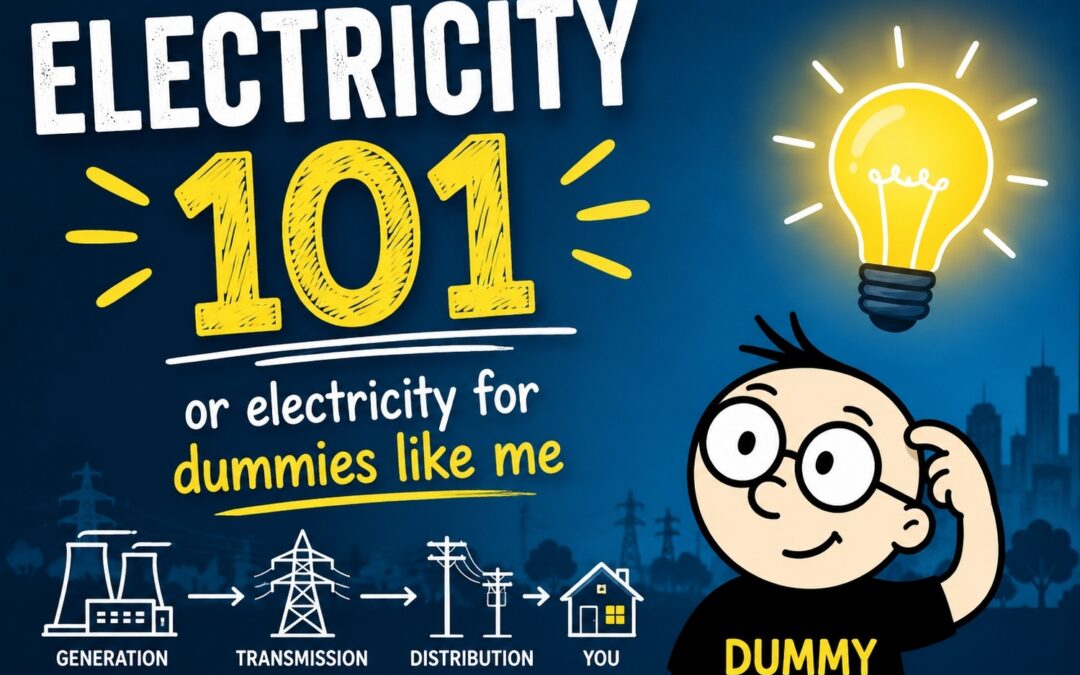
I hope this Electricity 101 style summary, of the EIA’s book-length websites of Energy Explained and Electricity Explained, proves to be a handy resource for other dummies like me. But more importantly, it also serves as a timely reminder that energy makes any work possible, and electricity makes all work easier, as well as a Labor Day holiday even possible.
To the feeble powers of our arms and hands is added the enormously greater power released by energy in the form of steam, internal combustion, electricity, or radiation. In this way, energy use, the productivity of labor, and the standard of living are inseparably connected, with the two last entirely dependent on the first. – George Reisman, Capitalism: A Treatise on Economics
