A new school year is underway and parents have some homework of their own — knowing what rights they have within the public education system and how to exercise them so they can play an active role in their child’s education.
American Experiment’s Minnesota Parent Toolkit is a helpful resource that explains the different ways parents can get engaged and includes specific forms for them to submit to manage the boundaries of instructional content their children receive.
Curriculum review & opt-out
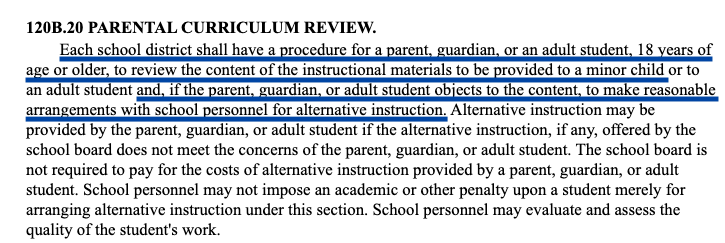
Under Minnesota Statute 120B.20, a school district must have a procedure in place for parents to review the content of the instructional materials provided to their children and, if the parent objects to the content, make reasonable arrangements with school personnel for alternative instruction. Alternative instruction may be provided by the parent if the alternative instruction offered by the school board does not meet the concerns of the parent. The student cannot be penalized for using alternative instructional materials.
This state law complements a recent U.S. Supreme Court decision (Mahmoud v. Taylor) that affirmed parents have the right to opt their children out of instructional materials that violate their religious beliefs. Using this form from the Pacific Justice Institute, parents can note the instructional content they would like their child exempted from, as is their right under Minnesota state law as well as the First Amendment’s Free Exercise Clause as affirmed in Mahmoud v. Taylor (2025) and Pierce v. Society of Sisters (1925).
Survey opt-out
Parents also have the right to opt their child out of surveys and questionnaires that ask students about their political beliefs, mental problems or challenges, sexual behavior or attitudes, illegal or self-incriminating behavior, critical appraisals of people with close family relationships, relationships with lawyers, doctors and ministers, religious beliefs or practices, or income level (unless asked to determine participation eligibility).
These eight areas are considered protected information under the Protection of Pupil Rights Amendment (PPRA) and as such, schools that receive federal funding are required by federal law to inform parents of any survey or questionnaire that gathers this information and to obtain their prior consent.
Additionally, parents have the right to inspect, upon request, a survey created by an outside entity that a school district wants to distribute or administer, along with any supplemental material (such as a teacher’s manual) that comes with the survey. Students can also tell their teacher they do not wish to take in-class surveys, questionnaires, or emotional “check-ins.”
Parents should ask their principals what the opt-out process is in their district. Many have district-specific opt-out forms that simply need to be signed at the beginning of the school year and turned in to school officials.
Sex education opt-out
Under the same Minnesota state law cited above for opting out of instructional materials, parents can opt their child out of sex education. Perhaps there are components a parent feels more comfortable teaching his or her child or that violate a parent’s religious beliefs. (For example, proposed statewide health standards would require third graders to “describe internal and external reproductive body parts using medically accurate terms in a gender-neutral way” and “explain the difference between sex assigned at birth and gender identity and expression.”)
Serve on a District Advisory Committee
A school board must establish an advisory committee to ensure active community participation in all phases of planning and improving instruction and curriculum affecting state and district academic standards. Whenever possible, parents and other community residents must comprise at least 2/3 of advisory committee members. Interested parents should ask their school board for more information about serving in this capacity.

Have a great school year, and remember, knowing your rights helps you better partner with teachers and school administrators to make sure your child is supported and successful!