
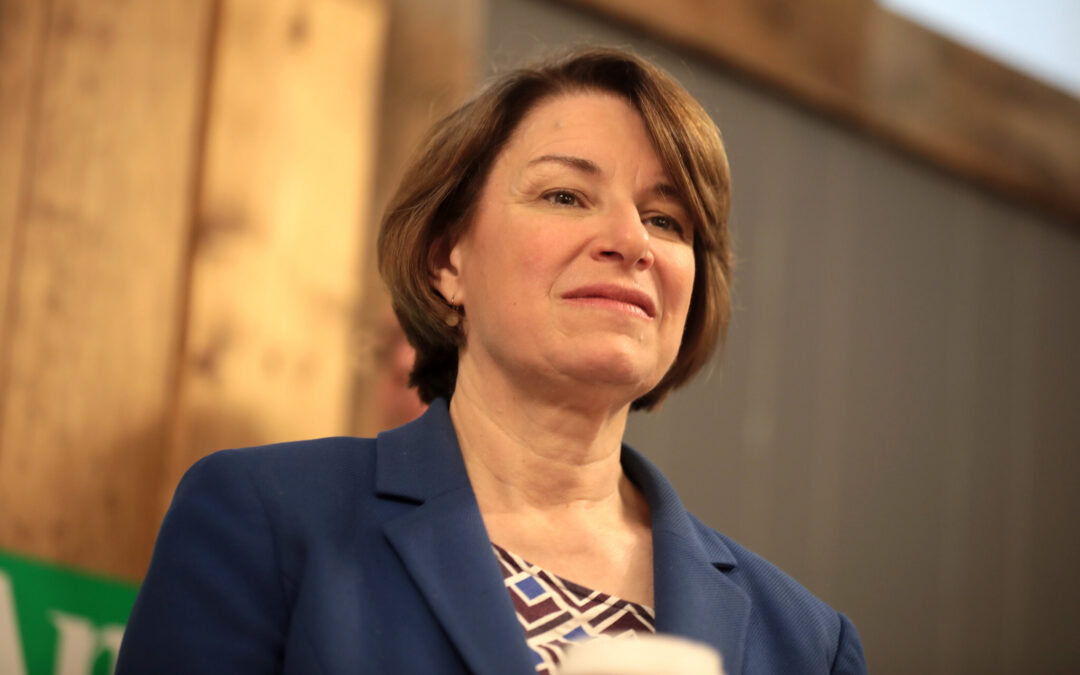
Senator Amy Klobuchar speaking with supporters at a meet and greet at the Northside Cafe in Winterset, Iowa by Gage Skidmore (CC BY-SA 2.0) (https://www.flickr.com/photos/gageskidmore/48208414647/in/photostream/)
The issue
Our most recent Thinking Minnesota poll asked “Which of the following affordability issues would you MOST want candidates for state office to focus on in 2026?” The second most popular answer was “Lowering Health Care Costs,” with 34%.

As MPR News reported this weekend:
Health insurance premiums for thousands of Minnesotans are expected to increase in 2027.
The proposed rate hikes are primarily driven by rising healthcare costs, inflation, and the expiration of enhanced Affordable Care Act tax credits that previously made coverage more accessible for many consumers.
Premium increases would affect Minnesotans who purchase either individual or small group health insurance directly from insurers or through MNsure, Minnesota’s health insurance marketplace.
…
Preliminary rate filings from the Minnesota Department of Commerce indicate that the state’s insurers are seeking average premium increases ranging from 10 percent to 13 percent for 2027 plans on the individual market, and between 7 percent and 21 percent on the small group market.
This promises to be yet another squeeze on Minnesotan’s budgets.
A solution?
Sen. Amy Klobucar, the DFL’s nominee to replace Tim Walz as Minnesota’s governor, claims she has a plan to deal with this.
The Minnesota Reformer reports that:
If the federal government fails to extend federal subsidies that offset healthcare premiums, Sen. Amy Klobuchar, as governor, would create a state tax credit to help with those skyrocketing costs.
…
…if Congress doesn’t take action, Klobuchar said she would create a state tax credit targeted at small business owners, self-employed workers and farmers who are hit hardest by the expiration of the federal subsidies.
…
Klobuchar’s healthcare plan also includes creating a per-employee tax credit for small employers who fund their workers’ coverage.
No
Our recent report “Supplying Hope and Demanding (Real) Affordability: An agenda for Minnesota’s future” takes an in-depth look at the issue of affordability, its causes and solutions.
We note that:
Affordability problems at the state level are generally supply-side problems of insufficient production, not demand-side ones of insufficient spending power. Credits do not fix these problems, they lower no prices, all they do is transfer the cost to taxpayers which, in turn, exacerbates affordability problems in the most direct way possible by increasing the price Minnesotans must pay for their government.
The bottom line is that Klobuchar’s plan lowers no costs or prices, all it proposes is shifting them to Minnesota’s already hard-pressed taxpayers.
The cost of tax credits
I previously wrote a quick recap of the history of these tax credits.
When it became apparent that the Affordable Care Act (ACA) of 2010 had completely failed to provide affordable care, the premium tax credit was created in 2014. It provided financial assistance to lower- and middle-income Americans purchasing health insurance through the ACA marketplace. In 2021, the American Rescue Plan temporarily expanded the tax credits for two years, increased the amount of assistance, and eliminated the rule that prevented households with incomes over 400% of the federal poverty line from qualifying. As my colleague Matt Dean noted recently, “When the Inflation Reduction Act [IRA] passed in 2022, every Democrat in Congress [including Sen. Klobucar] voted for these subsidies to expire in 2025.” Indeed, the IRA “passed without a single Republican vote.”
Indeed, as Senator, Klobuchar voted for these credits to expire as they now will.
These expanded credits were one of the “temporary” Covid-era federal spending programs financed by printed money which gave us the worst inflation in 40 years. But Klobuchar isn’t running for office in D.C. anymore and, as governor, would not be able to rely on either the federal budget deficit or Federal Reserve to finance this scheme. So how will she pay for it?
The Minnesota Reformer explains:
Minnesota’s future budget outlook is uncertain, as state spending is expected to continue to outpace revenue in the next few years. Asked how she would deal with the cost of the tax credits, Klobuchar said she expects to find cost-savings in the top-to-bottom audit of state government she will do as soon as she takes office.
Klobuchar said that as Hennepin County attorney, she did the same thing to the state’s largest prosecutor’s office, analyzing the budget and determining areas where it could cut duplicative services or save money by moving employees around.
This is the old politician’s trick — beloved by all parties — of promising free stuff without anyone having to pay anymore because of some supposed “efficiency” savings.
Perhaps Klobuchar has been in D.C. too long. When she arrived there in 2007, federal debt stood at $9 trillion and is now upwards of $37 trillion, but you can’t carry on like that in state government where budgets have to be balanced. Klobuchar’s plan wouldn’t lower a single price, but it would hike your taxes. For a real solution, look at our report, pages 28 to 31.