
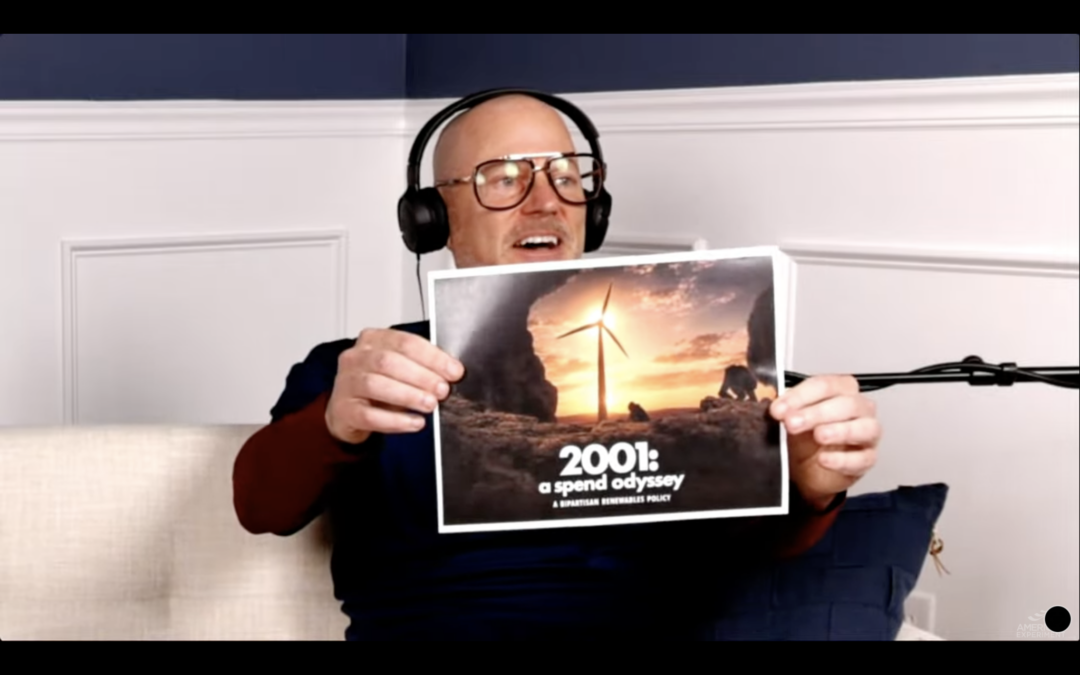
I had my second appearance on The Jon Justice Show earlier this week on Monday the 28th of September. The focus was on NIMBYnomics, renewables and energy affordability.
A 55 seconds clip from that appearance can be found here => https://www.youtube.com/shorts/Qp6izVuksBI
My entire appearance can be found here from 2:38:30 to 3:09:06 => https://www.youtube.com/watch?v=zRMHcNVzrtE
Highlights from an AI-generated transcript follow next =>
Jon Justice (JJ): Talking about space. 2001: a spend odyssey (a bipartisan renewables policy). What is this all about? Policy fellow Darren Nelson joins us on the comfy sofa here at the Center of the American experiment. Good morning, Darren. Good to see you this morning, my friend.
Darren nelson (DN): Good morning. I have a couple speeches to do this week, one tomorrow at the Council of State Governments [CSG] for the Midwest [and the BIOBY mining and energy expo after that]. And [the CSG are] talking about nuclear power and [nuclear waste]. I’m just going to go there and talk about what’s been happening with energy prices since 2001. Which is when sadly a Republican governor put in the first renewables piece of legislation, and then prices have largely taken off [in] 2002 onwards.
JJ: Let’s get into the piece you have regarding NIMBYs, you labeled it NIMBYnomics. The one thing I appreciate about this is how you differentiate, and you’re right, between the good NIMBY and the bad NIMBY. So talk a little bit about your piece, the public choice economics, not in my backyard, and what you broke down in this bipartisan phenomenon.
DN: I’m an economist. That’s the way I tend to look at things for the most part. So there’s a school of thought [from] the 1960s called public choice economics, and it gives the best insight into what NIMBYs are, why there’s NIMBYs, and what you might be able to do about it. Because, as you said, there’s bad NIMBY situations that you would like to overcome if you can. And what they suggest [is to] essentially buy them off legally. A better word is a compensation.
They often do have genuine concerns. Sometimes [these are] more psychological. So that’s a lot harder to compensate for. But sometimes [NIMBY’s are worried that something is] going to lower land values. There’s going to be noise. There’s going to be maybe pollution, that sort of thing.
Public choice economics is basically the economics of government and politics. Some Nobel Prize winning economists realized [that] supply and demand, self interest, don’t stop when you get into the institution of government. Most people kind of realize politicians are fairly self interested for the most part. But bureaucrats [are] self interested too. They have some slightly different incentives, like being entrenched over time. Politicians want to win elections. They want at least legal kickbacks, or at least good jobs to come afterwards. Public choice formalized what a lot of people strongly suspected for centuries.
JJ: So when it comes to getting a better addressing this NIMBYism, what is the aspect of [public choice economics ] for you personally that you find most compelling in terms of when people are bringing forth these arguments?
DN: As an economist, I’ve always been really passionate about cost benefit analysis, or at least the concept behind it. Because politicians and other people involved in politics, they always claim there’s just benefits to this thing, or there’s just costs to this [other] thing. No, there’s always costs and benefits to everything. And what’s important to realize [too is] that they also impact people differently.
The NIMBY is driven by costs being greater than benefits in a particular situation. That’s what’s driving [them], and those costs can be monetary, but they can also be just genuinely psychological ones. And those are real, [as] people get very motivated by something they feel [is] bad, that’s like a cost to them. Or sometimes the property values will go down, or sometimes both.
One I didn’t actually mention in [my article], the good NIMBY that I have the most empathy for is the one who doesn’t like the pickleball courts right next to their house. Because they are unbelievably loud. It looks like a very fun sport. I’ve never actually played it myself. And a lot of the people who are NIMBY about pickleball courts right next to them, love the idea of pickleball, they just don’t want it near them. We could talk a bit broader about data centers and nuclear power. Some people don’t want them anywhere, even if it’s nowhere near them. Even if they like [to] use data centers [and] appreciate the fact they exist.
JJ: But it seems like we’re not allowed to have those discussions within our media of the nuances of all this. Your articles drive into the heart [that] we need to have further discussions about the benefits [and costs] of [NIMBYs, nukes and data centers].
DN: One thing I want to kind of be provocative about is [that] the economic law of supply and demand [as well as] cost benefit analysis, [are] actually more scientific, more grounded in reality, than physics. Physics actually has at least three different theories of gravity. They talk about physics [as] the ultimate science [and] it [has] risen to the level of fact. Well, they don’t even know what gravity is, much less even describe it in one theory. They [have] three theories [of] Einstein, quantum mechanics, and Newton.
I’m not saying economics has all the answers and it’s always right, because there’s different schools of thought within economics. And I’ll be very transparent about that because most people aren’t. Most people just go, this is what this science says or this is what this economics says. Okay. What’s your school of thought that you’re drawing upon? I’m drawing upon free market schools of thought. I think they’re right. They don’t have all the answers, but I’m going to be transparent, unlike our friends on the left who are never transparent on those fronts.
JJ: What is it you think they’re going to be keying in on regarding your view when it comes to renewables?
DN: Look, [the conferences audience] may not be convinced by the kind of economics that I hit them with and the logic of why these [renewables] are inherently costly. When you start [to] subsidize stuff, [although] it’s probably counterintuitive to some people, but ultimately you incentivize: those costs to go up and up; and the subsidies to get bigger and bigger.
It’s often claimed that [renewables] were expensive once upon a time, but now they’re not. You just subsidize them more and more and more and more. That’s not really making them cheaper. You’ve actually incentivized them to do the opposite. So, okay, they may not be impressed by that logic, but [perhaps they will be by] the facts of what’s actually happened to prices since 2002 in Minnesota. And not just Minnesota, [but] the Midwest and also the US in general, [prices] all took off from 2002, which is when Minnesota and a whole bunch of other states started to put in these renewable policies.
If prices start going up, you’ll see the usage rates go down. And that’s what we’ve seen [after] 2008. The actual total use of electricity in Minnesota hits a peak and it goes down across residential, commercial and industrial. And basically, one thing about energy is that it’s [the] sort of product when it gets cheaper, you want to use more of it, and you can use it in all sorts of different ways. Energy is the master resource. You never want to be using, overall total, less. You might want to be more efficient in the use of it in one area, and start using it in more areas. We were using electricity a lot before the digital age, now it’s on steroids in the digital age. All this digital stuff relies on electricity. There’s no such thing as digital without electricity.
JJ: Darren Nelson, thank you so much for [your] time this morning. It’s always great to talk with you. I encourage everybody to head on over to americanexperiment.org and check out Darren’s writings. And good luck on your speeches this week.
DN: Hopefully they’ll learn something, and we’ll have a good chitchat afterwards. Thank you for having me, and “always a pleasure.”
Note: “Always a pleasure.“ In memoriam of Dr. Yukio Hattori.
