
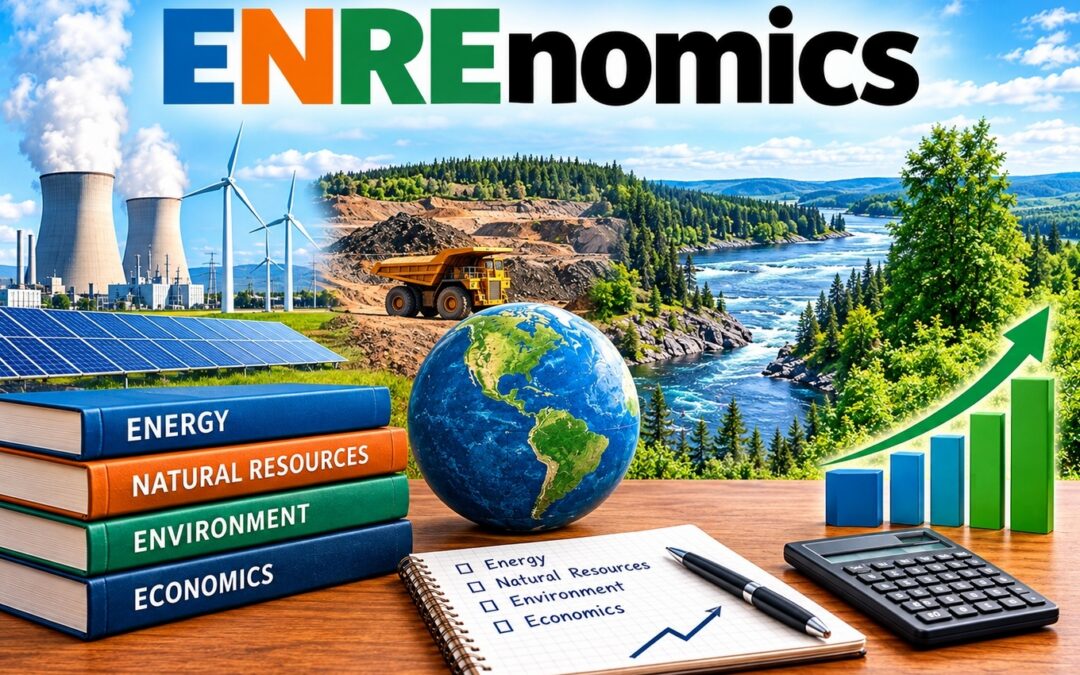
ENREnomics is the Economics 101 of Energy, Natural Resources and the Environment. ENRE can be pronounced “aan·ree” like the last name of the CBS soccer commentator, and Arsenal football club legend, Thierry Henry.
My ENREnomics 101 is based on the wonderful work of mainstream, but free-market friendly, economist Professor Barry Field of the University of Massachusetts Amherst. He is top-shelf when it comes to the economics of the environment, natural resources and energy.
His 2023 textbook addresses: value and costs; markets and efficiency; sustainability and biodiversity; property rights and public policy; as well as economic growth and globalization. It covers: minerals; energy; forests; fisheries; land; water; agriculture; recreation; and wildlife.
Environmental Economics 101
It may be considered a cliché, but economics really does come down to demand and supply. The demand side includes: for no use like preservation; and restricted use like conservation. The supply side is driven by opportunity costs, informed in no small part by accounting costs.
Virtually any human action affecting natural resources use rates has two consequences: on the one side it normally creates goods or services that have value and demand on the output side; on the other side it entails costs and supply on the input side. (p. 37)
Public goods are not those labelled public utilities, nor considered in the public interest, but are those that are non-excludable on the supply side and non-rivalrous on the demand side. The former means suppliers can’t charge and the latter means consumers won’t pay anyway.
Goods and services are defined as public or private in microeconomics by their technical characteristics, not by whether they are produced by public agencies or private firms. (p. 46)
Positive and negative externalities, such as reducing or increasing pollution, are considered, along with public goods, as market failures. The most common response to these are taxes, subsidies and regulations. However, government failure can negate or make matters worse.
The difference between private costs and social costs is called external costs. External costs, in other words, are costs incurred by people who are not party to the decisions that give rise to them. (p. 87) … External benefits can be present in the same direct way that external costs are present. (p. 88)
Natural Resource Economics 101
Some economists like George Reisman go further to suggest that the supply of matter and energy, including non-fuel and fuel minerals, is almost infinite. Also, scientists proved “fossils from animals and plants are not necessary for crude oil and natural gas to be generated.”
[E]xtracting non-fuel minerals…appear to be classic examples of non-renewable resources. This is true in some ultimate physical sense, but the processes of exploration and discovery and the technological ability over time to utilize increasingly lower grades of ore give these minerals the characteristics of a renewable resource for the foreseeable future. (p. 190)
Water is often thought of as a public good or public utility to be administered or supplied by government. This presupposition has at times been challenged in places like Australia, Chile and Scotland. Fresh water is super-abundant in places like Minnesota and should be cheap.
If there are reasonable levels of competition among buyers and among sellers, well-defined property rights, and few important externalities, the established prices and the quantities traded are socially efficient. … But in the real world any number of factors can upset this process. Some are technical,…others are political/administrative, managed by public authorities according to a variety of political and economic motives. Water is a good example of the latter. (p. 294)
Energy has been labelled by economists such as Robert Bradley as “the master resource,” but economists like Julian Simon have crowned people as “the ultimate resource.” The latter demonstrated that a pro population policy is pro energy, environment and natural resources.
Throughout the 20th century, both demand and supply have increased. The most important factor behind the demand shifts has been demographic growth; more people demand more food. Factors pushing out the supply function are technological and institutional in nature: more productive biological stock, machinery, fertilizers, irrigation, business practices, and so on. Most notable is that technology has developed faster than population; thus supply shifts have outstripped demand shifts, so food production has more than matched population growth. The point at which these factors intersect is the price of food. For most of the previous four decades, agricultural prices have been reasonably level, with occasional upward spikes[.] (p. 314)
Energy Economics 101
In physics, energy is the capacity for doing work. In economics, energy gives greater capacity for doing more work with less. It does this by increasing the productivity of labor, land and capital, which thus enhances product innovation, price competition and wealth creation.
Total energy use is clearly tied to total population. But for a given population, energy use is also related to income. Wealthier societies consume more energy—not only do consumers use larger amounts of energy as their incomes rise but also greater industrial and commercial energy consumption is what produces the higher incomes in the first place. (pp. 198-199)
I have documented many times before that renewables in Minnesota are not only “more costly” but also have resulted in a “reduction in the demand for energy.” For example, electricity use declined since 2002 by: 8% residential; 11% commercial; and 52% industrial.
If a widespread shift into renewable forms of energy implies adopting more costly energy, as compared to fossil energy, the higher costs and prices would imply a reduction in the demand for energy. But consumer energy prices are politically sensitive. [T]his has led to a grand attempt to publicly subsidize the shift to renewables, thereby shifting the cost from energy users to taxpayers. (p. 208)
As I wrote recently, renewables are increasingly unpopular according to polls, but also according to returns of -7.36%. The latter is despite being propped up by either taxpayers subsidies, or franchise monopoly cross-subsidies, or some combination of the two.
Competition is not desired for its own sake but for the positive economic effects it is expected to have: Competing firms are motivated to produce at the lowest possible cost and sell their electricity at the lowest possible price. … If a consumer wishes to buy “green power” (power from companies that use wind, solar, or other renewables), for example, they can do this by searching for the appropriate supplier. (p. 211)
ENREnomics 101 Conclusion
Why economics matters in life was encapsulated by my friend Jeff Deist in March 2015 as:
Economics is like gravity, or math, or politics — we may not understand it, or even think about it much, but it profoundly affects us whether we like it or not. … But somehow we’ve come to believe economics should be left to academics and policy wonks.
Why economic matters in policy was epitomized by the once president of the Mises Institute:
Ignorance of basic economics is so widespread that we ought to have a specific word for it, like we have for illiteracy or innumeracy. … It is this great and widespread ignorance…that plagues our political landscape. … It allows politicians to blame free markets for the very economic problems caused by the state in the first place.
Thus, it is about time “We the People” set free the energy, natural resources and environment of Minnesotans, from the unaffordable shackles of the state elitists and crony capitalists, e.g.:

Source: Natural Resource Economics: An Introduction by Barry C. Field from August 1, 2023