
Last week, I conservatively costed the proposals contained in the DFL’s Minnesota Values Project Policy Agenda 2027 and arrived at a figure of $13.5 billion in new spending each year, with the tax hikes to match.
What does this look like in the context of Minnesota recent fiscal history?
The trifecta’s legacy
As I’ve written before, in February 2023, Minnesota Management & Budget (MMB) forecast a surplus of state government revenues (“Subtotal Current Resources”) over spending (“Total Expenditures & Transfers”) totaling $19.7 billion in the five years 2022 to 2027, as Figure 1 shows. The “historic” DFL trifecta, elected in November 2022, used this money to go on a spending spree, blowing not only that forecast surplus but more besides. By the end of the 2024 session, while revenues were largely unchanged, spending was forecast to be $22.5 billion higher in the four years 2024 to 2027 than it had been when the trifecta took office in St. Paul and was now forecast to outstrip revenues in that period by $11.5 billion.
Figure 1: Forecast Minnesota state government spending and revenues, billions

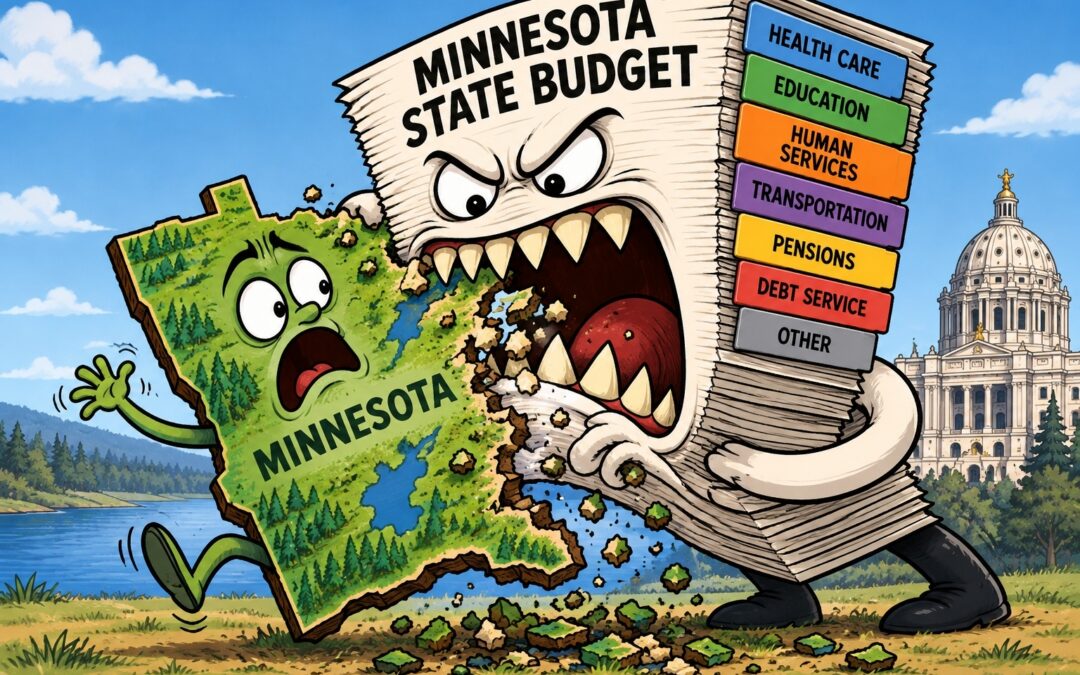
The trifecta sessions were a horrendously managed orgy of fiscal excess which have left Minnesota with a persistent budget deficit.
As I have written before, Minnesota’s state government has been running a deficit since 2024 and, at the end of the 2026 session, was forecast to spend more than it collects in revenue in every single year from 2026 to 2029 for a cumulative deficit of $5.5 billion, as Figure 2 shows.
Figure 2: Minnesota state government spending and revenues, billions

Plans for a new trifecta
What happens if we take into account the DFL’s plans for new spending?
Figure 3 shows that, with the DFL’s extra $13.5 billion added to the forecasts for 2027 onwards, Minnesota’s state government would be spending $14.7 billion more in 2029 than it is this year, an increase of 41% or 112% since 2020, the last year of budget normalcy. And, of course, Minnesota cannot borrow or print this money, it will have to be extracted from the state’s residents with higher taxes. Figure 3 also shows that, to finance the DFL’s new spending and close the existing budget deficit, taxes would need to be $16.5 billion higher in 2029 than they are this year, an increase of 49% or 117% since 2020. Under the DFL’s proposals, Minnesota state taxes and spending will have more than doubled in just ten years.
Figure 3: Minnesota state government spending and revenues, billions

Free stuff gets real expensive, real quick.