
I, Darren Nelson (DN), recently joined my colleagues, and American Experiment podcast hosts, of Kathryn Johnson (KJ) and Grace Keating (GK) for about 20 minutes on the couch for Episode 144, which was released on September 15, 2026.
We opened up with a discussion of my professional and geographic background and how I ended up becoming the Energy Policy Fellow at American Experiment. The focus for the rest of the interview was on Minnesota’s 2021 Natural Gas Innovation Act (NGIA).
The NGIA is not about “Natural Gas Innovation,” but is instead about “Natural Gas Exnovation!” Exnovation is defined as “the process of terminating a practice, or the use of a technology or product, within an organization, community, or society. Put simply, it can be described as the opposite of innovation.”
My appearance on the show starts from the 30:11 mark, and ends at the 52:31 mark. Some of the highlights from this are extracted from a ChatGPT generated transcript, of about 4,400 words, and about a third of that is quoted below. Enjoy.
GK: We are so happy to welcome to the show now Darren Nelson, who is one of our policy fellows here at American Experiment, focusing on energy and natural resources. Welcome to the show, Darren. Since this is your first time on the American Experiment podcast, you’re relatively new here. Why don’t you start by just telling us a bit about your background and how you ended up here?
DN: The second one’s a little bit harder. But I’ll start with my background. I’m an economist by trade. I’ve mainly done most of my work in Australia. I’m originally from the U.S., from next door in Wisconsin. But I did study at university in Australia, did an economics degree, also did a master’s of law. And, to make a long story short, I’ve been a sort of freelance think tanker for probably the past decade or so. And I guess I finally decided it was time to settle down and stay with the one think tank. So that’s why I’m here. And I think I started on June 1st. So I’ve been here all summer long.
KJ: Basically, a few years ago there was a very innocuous-sounding law passed here in Minnesota called the Natural Gas Innovation Act. And, I mean, I don’t know—explain to us what this is about, because it was a bipartisan bill. It’s called something nice, the Natural Gas Innovation Act, but there’s actually some maybe bad stuff in here. So talk a little bit about that bill.
DN: Actually, it’s not so much that there’s bad stuff in the act. The act is just bad. So you look at it, it’s like a dozen pages long. It’s not overly humongous, but it is very technical. But it’s virtually almost on the last page where they give the goal of this whole thing, and the goal is basically to get rid of natural gas, particularly for residential and commercial. They also have some exemptions for big industrial users, perhaps data centers and for electricity generation. There’s no timeline in it, like some of the clean energy stuff for electricity, as you know, 2040 and 2050. It’s kind of a bit vague, but they’re trying to basically replace natural gas with all sorts of weird stuff like heat pumps and things like that.
GK: That was kind of my first question when I first started learning about this bill that passed: What does this look like in practice? Are these agents from CenterPoint Energy, you know, going to be coming into homes and taking out natural gas equipment, or what does this look like?
DN: Sadly, I don’t—it might get to that at some stage in the future, but right now, basically, as you mentioned, CenterPoint, but also Xcel. A lot of people don’t realize Xcel is also a natural gas company. They’re mainly an electricity company that does natural gas. CenterPoint’s the opposite: they’re mainly natural gas and do some electricity. At this early stage of the process, they’re doing all these pilots and R&D projects. And they’re spending a lot of money on this and they’re going to pass this on to us. So basically you will pay, eventually, to get rid of your own natural gas. So it’s very odd.
KJ: Well, okay. Why does CenterPoint Energy want to get rid of natural gas if that’s what I pay them for, right? Isn’t that primarily what they do? So what is their goal here?
DN: Well, sadly, you know, they’re a franchise monopoly, just like Xcel are a franchise monopoly. They’re part of this Public Utilities Commission system. Xcel, I get, because they’re trying to get more electricity customers. These heat pumps and all these other technologies—almost all of them use a lot of electricity. This is kind of Machiavellian on their behalf. It’s like, they are happy for the natural gas business to disappear because it doesn’t earn them a lot of money compared to their electricity business. CenterPoint, I don’t quite understand, except that, a lot of people just go along with this climate-change-related stuff, and they don’t speak up until it’s too late.
GK: So what’s with the hate on natural gas from the left at a very fundamental level? It’s all part of the carbon-free climate initiative here?
DN: Correct. Obviously, compared to something like wind and solar or nuclear, the burning of natural gas involves a fair bit of carbon dioxide. But a lot less than, say, coal, for instance.
KJ: Okay. I mean, I was shocked about how this—like you said, this legislation is relatively old. Why are we only hearing about it now? I mean, 2021, right, was when Walz signed it?
DN: Maybe because it has that nice name or something. There were some news articles written about it at the time, but I don’t think it opened to a lot of fanfare, as opposed to their electricity initiatives—having carbon-free electricity by 2040 and the entire economy being net-zero by 2050. So I’m not really sure. I can’t even remember how I came across it myself, to be honest, but I spotted it.
GK: Now, one element of this that especially concerns me, and I think most of our listeners will be concerned as well, is what the Natural Gas Innovation Act—the NGIA—is going to do to home heating prices. Can you speak about that?
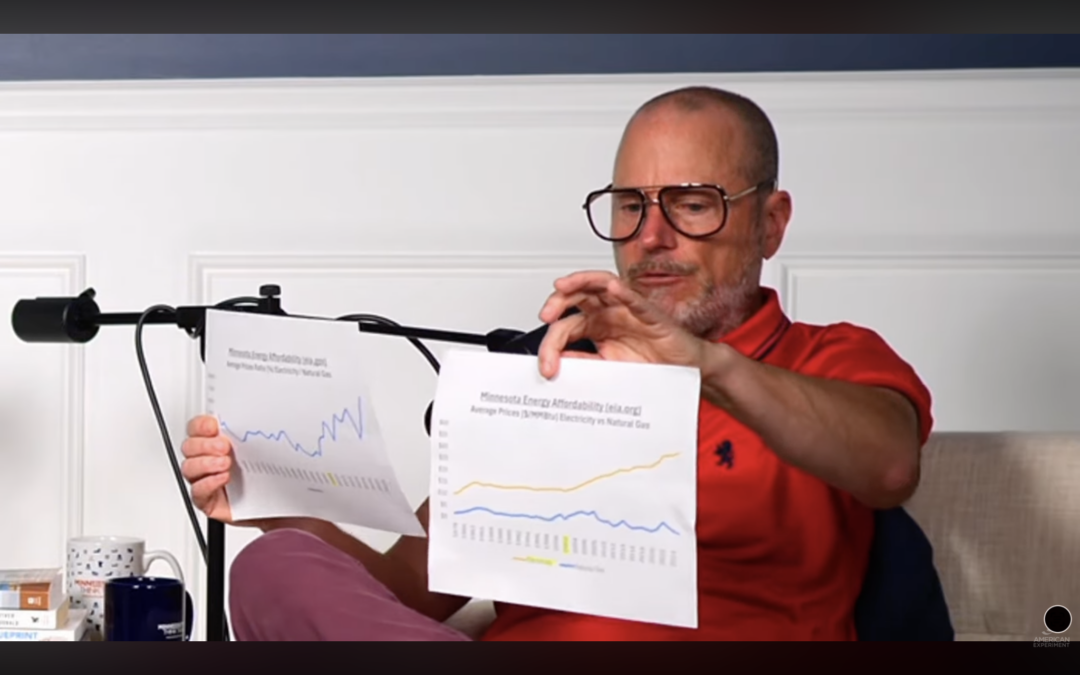
DN: I’m plotting electricity and natural gas prices. So you take kilowatt-hours and then eventually turn it into BTU, so you can actually compare these two prices. So you can see natural gas isn’t too bad. You know, it’s kind of largely flat. Goes up and down a little bit over time. Electricity starts to take off basically right from when renewables start coming online, and it gets worse and worse and worse. This one is showing it’s charging more for electricity. So it’s basically up bad—flat or going down good.

DN: And then these two are combined in this one where it’s basically a ratio of electricity to gas prices. The takeaway is ultimately here that electricity is like 700% greater in price than natural gas. It’s like kind of around 300% when renewables come online. So it more than doubles. If you took natural gas away—all the heating and all the stuff we use it for—and everybody has to start using heat-pump electricity and other sort of electricity, you could basically be tripling prices of electricity.

KJ: Well, that could be sort of an answer to some of the questions I had about, like, CenterPoint Energy, for example. Why would they ever be on board with this? Well, maybe they think, okay, in a future world, we could make more money off of electricity.
KJ: Another element that I wanted to ask you about is reliability, because obviously we live in Minnesota, it gets super cold, we need to heat our homes. And with natural gas, it seems like—isn’t that the most effective way? Would these heat pumps be equally as reliable in negative-10-degree weather in Minnesota?
DN: It’s like, you know, I’m no engineer, but I did do some research on this and basically you might not freeze to death. But, you know, these kind of—these geothermal heat pumps in particular, the ones they like better than air heat pumps—you know, I think in a place like Minnesota, you might be able to keep your house at a really—like 48 degrees, basically. So, you know, you’re not going to die.
GK: This is already law, is what I was going to ask. This is already law. So, what can be done now to prevent this apocalyptic vision of Minnesota from cold showers?
DN: I think there’s two things. If you don’t like the sound of this, there’s a public process going on right now with the Public Utilities Commission. Now, the PUC can’t change the legislation, but because it’s so vague, I think you start putting pressure on them. They’ll start going, ‘Oh, wait a second.’ Send a signal to the PUC, send a signal to Xcel, CenterPoint: ‘Wait a second, we missed this in 2021, but we’re on to it now!’ But the other thing you can do at the same time, obviously there’s an election coming up. This is the time, and I understand even DFL candidates are not running on climate change at the moment. So, put the pressure on the DFL candidates. Put the pressure on the not-so-strong GOP candidates. Hopefully we’ll have some strong ones. Ultimately we would like the NGIA to be repealed. You could maybe have a two-for-one where they get rid of the nuclear moratorium.
GK: We’ll obviously be following these issues very closely here at American Experiment on the podcast, so stay tuned for more. And Darren, thank you for coming on today.
DN: “Always a pleasure.”
Note: “Always a pleasure.“ In memoriam of Dr. Yukio Hattori.
Also Note: The two charts I held up on the show are reproduced above and are from my article on September 3, 2026 of Nukes and natural gas: End two bans, for the price of one.