
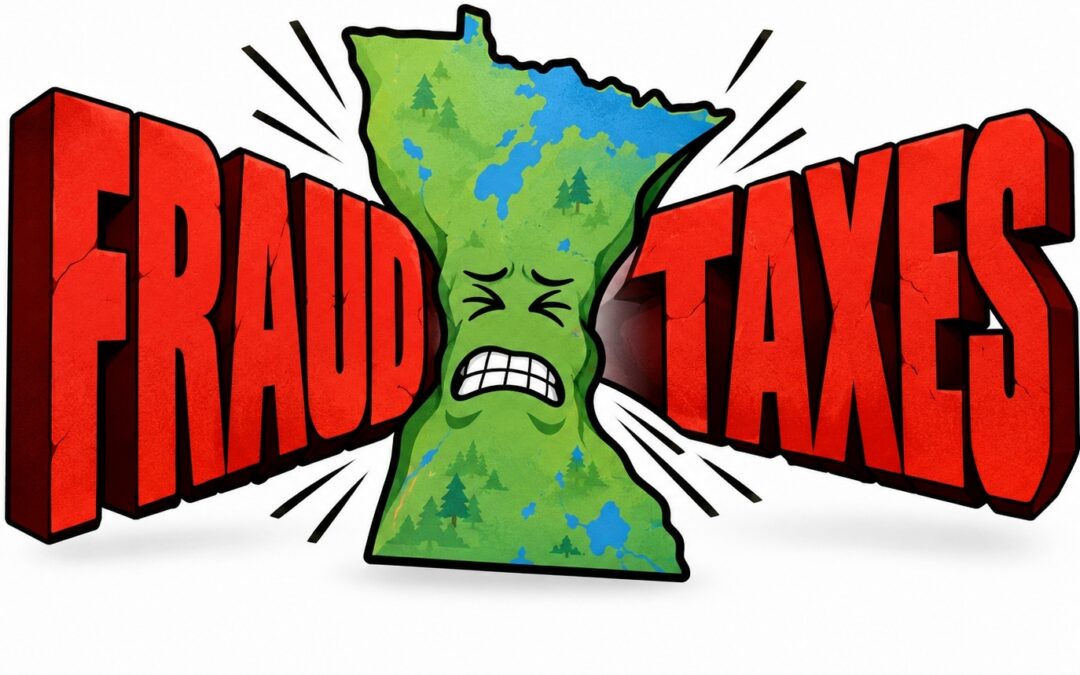
It might be useful to pull together a few things I and my colleagues have written recently.
Billions lost to fraud
First, despite the local media’s desperate attempts to obfuscate, it is probably true that billions of dollars of taxpayer’s money has been lost to fraudsters in Minnesota. As my colleague Bill Walsh wrote recently:
Joe Thompson of the U.S. Attorney’s office in Minneapolis…said that “half or more” of the $18 billion in spending on 14 high-risk Medicaid programs in Minnesota was fraudulent.
That is $9 billion just there.
Taxes on average earners increased
While our state’s fraudsters have been making out like bandits over the last few years, ordinary, law-abiding Minnesotan’s have been squeezed, in part, to pay for this.
The “historic” DFL trifecta of 2023/2024 hiked property taxes, sales taxes, gas taxes, and tab fees. Turning to the income tax, I noted in April that, for 2025:
…the average earning, single filing Minnesotan will hand over 4.9% of their 2025 wages to the state government, a higher share than in 43 out of 50 other states, as Figure 1 shows.
Figure 1: State income tax as a share of Average Annual Pay, 2025

This share is up 0.2 percentage points from 4.7% a decade ago, in 2016. Indeed, Minnesota is one of just 16 states where the share of the average earner’s wages swallowed up by the state government in income tax has increased over the last decade, as Figure 2 shows. In 20 states it has fallen.
Figure 2: Change in state income tax as a share of Average Annual Pay, 2016 to 2025, percentage point

Billions in fresh tax hikes
And Minnesotans could be facing a fresh squeeze after November.
Back in July, the Minnesota House reported, “DFL legislators from the Minnesota House and Senate unveiled the Minnesota Values Project Policy Agenda 2027. The agenda is the result of input from Minnesotans across the state and will serve as the guiding vision for lawmakers when they return to the Capitol in 2027.”
The agenda is 16 pages of fresh spending commitments, some large, and all on top of a budget which is already in deficit. It promises:
“Establish Universal Primary Care, because when everyone can go to the doctor
for a check-up, you avoid costly emergencies in the future.Expand access to public health care options like Minnesota Care, allowing more
Minnesotans to have health insurance outside of the profit-driven market.Low or no-cost child care access for every Minnesota family, as universal and in
as many towns in the state as we can make it. This will mean more investment
in public pre-K, Head Start, and community-based childcare in all corners of
the state.”And on and on. Its section on education, for example, is all about spending more money; there isn’t a single, solitary mention of actually boosting the state’s slithering educational outcomes.
All this new spending will be vastly expensive. By one estimate, providing free, universal childcare will cost the state government $10 billion in each biennium. Considering that the state is spending $71 billion in the current biennium, that is a 14% hike in state government spending before you even think about giving everyone free primary care and more access to Minnesota Care. We are looking at tens of billions of dollars in new spending, on top of budget deficits already totaling billions of dollars, just from these three proposals.
“[E]lections have consequences” – President Obama