
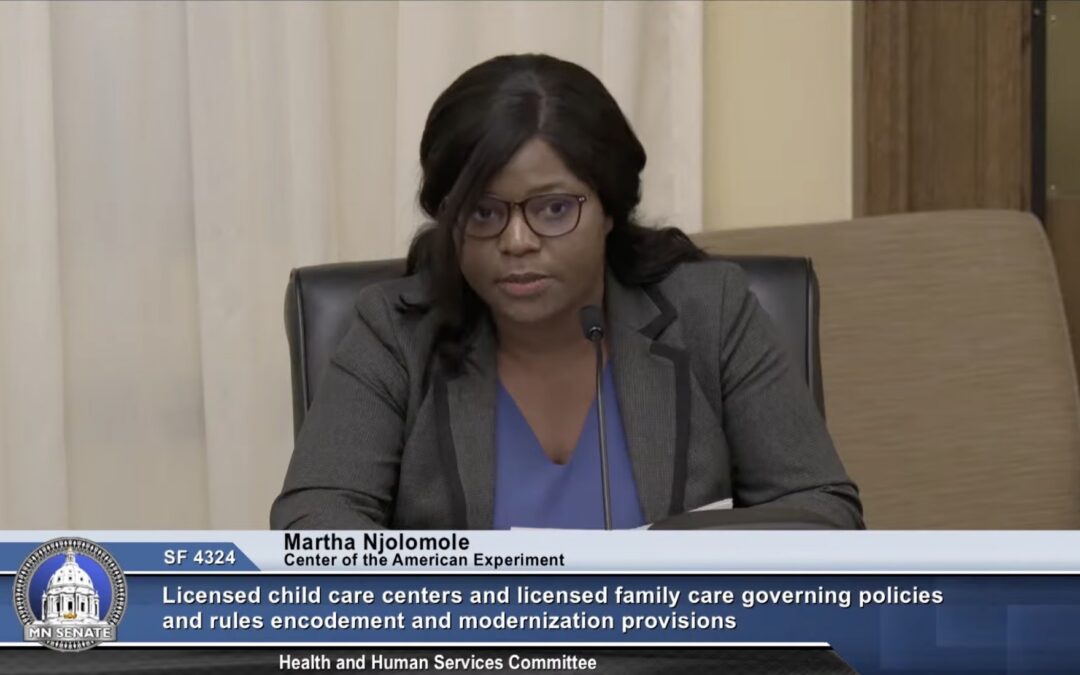
On Tuesday, the Senate Health and Human Services Committee heard SF 4324, a bill that would revise childcare licensing standards in Minnesota. I testified in favor of several provisions in the bill, specifically noting that Minnesota has one of the most heavily regulated childcare industries in the country, making reform necessary.
I specifically asked the committee to vote in favor of changes that are intended to:
- Reduce education and training requirements for center staff, including teachers and assistant teachers.
- Create a new family childcare license that would allow two caregivers to care for up to 18 children. Currently, a family childcare provider (with an assistant) can care for up to 14 children.
- Improve staff-child ratio flexibility for family childcare providers, allowing them to care for more younger children.
Why licensing reform is necessary
Minnesota is one of the least affordable states for center-based care. Empirical evidence suggests that this is due to overly stringent regulations.
In 2024, it cost over $20,000 for Minnesota families to send an infant to a licensed daycare center. After adjusting for income differences, Minnesota ranked as the ninth least affordable state, with infant center care costing twice as much as in South Dakota and 1.5 times as much as in North Dakota.
Figure 1: Annual cost of center-based infant care as a percent of Median family income

Unsurprisingly, in the State Childcare Regulations Index published earlier this year by the Archbridge Institute, Minnesota ranked as the 10th most restrictive state nationwide.
In the Midwest region, only Wisconsin, another high-cost state, maintains a more prohibitive regulatory environment. North Dakota and South Dakota both outperformed Minnesota on the index and on affordability. This indicates a strong link between regulatory stringency and childcare costs. South Dakota was, in fact, the country’s most affordable state.
Worsening the childcare affordability crisis further has been the accelerated exit of family childcare providers from the market, leaving parents with fewer affordable options.
Since 2007, Minnesota has lost over half of its family childcare capacity. In 2025, family childcare accounted for less than one-third of total capacity in the state. This is down from over 60 percent in 2007.
Figure 2: Child care capacity by type of license, 2007-2025

More changes are necessary to reduce the regulatory burden faced by providers, but SF 4324 is a step in the right direction. Among other things, the bill will:
Address center worker shortages. In 2024, the Department of Children, Youth, and Families (DCYF) issued over 4,000 variances to allow centers to hire workers who did not meet Minnesota’s hiring requirements. This indicates a structural mismatch between state rules and the qualifications of the applicant pool. It also suggests that some centers could be operating below capacity due to worker shortages. Reducing education and training requirements will make it easier for centers to find workers and improve childcare supply in Minnesota.
Enhance flexibility for family childcare. Family childcare providers continue to face falling demand for older children due to the expansion of publicly funded Pre-K programs. More flexible rules in SF 4324 will allow them to repurpose slots left behind by older children to care for more younger children, for whom childcare demand is rising, ensuring the long-term sustainability of family childcare.
Expand childcare capacity, especially in Greater Minnesota. Licensed centers are relatively less feasible to operate in Greater Minnesota compared to the Twin Cities. This is because centers require a high number of kids to sustain operations. Greater Minnesota has a lower population density. By allowing family childcare providers to care for more children, SF 4234 could help expand childcare capacity in Greater Minnesota, bridging the gap between demand and supply.