
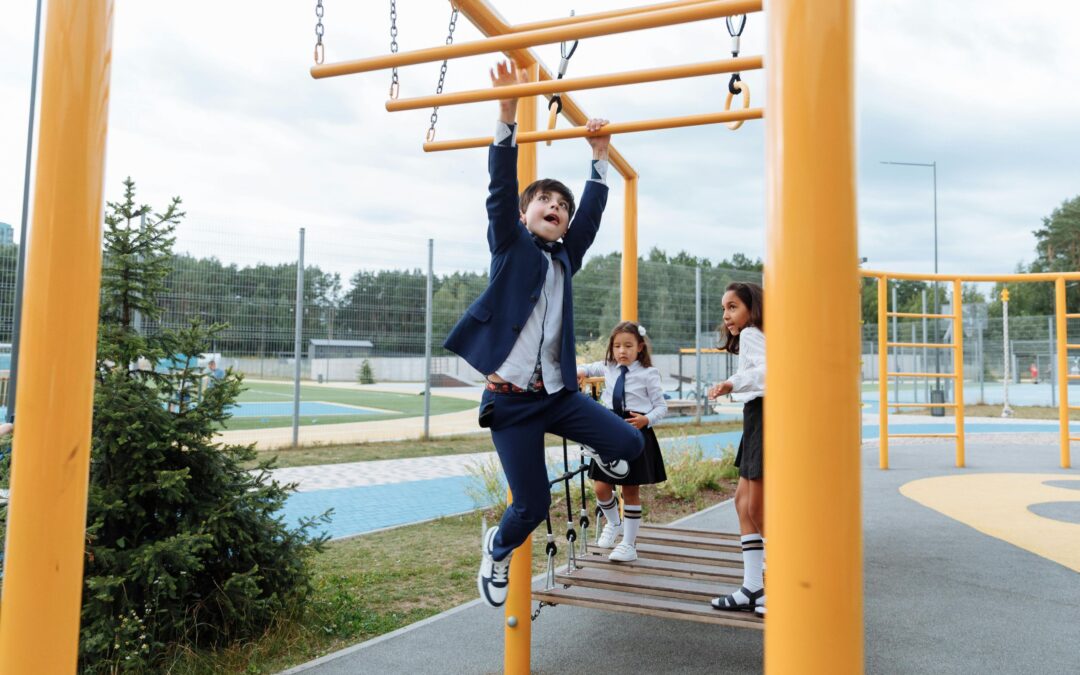
Anyone who has spent time around young children will observe that they overflow with energy. Running, jumping, climbing, frolicking, giggling, singing, and yelling, children have an innate need to use their physicality as they grow to understand their world.
New research centers this physical motion as one significant tool to ensure children’s healthy development. The 74 reports:
New research from the University of North Carolina, Greensboro, shows that when students engage in high-intensity interval exercises, they score significantly higher on standardized tests measuring verbal comprehension. In a study of elementary school children aged 9 to 12, researchers examined a type of brain neuroelectrical activity called “error-related negativity,” which occurs when people make a mistake and is associated with reduced focus and performance. What they found is that after acute exercise, the error-related activity decreased significantly.
Exercise, in other words, increases brain function for academics. The benefits of HIIT exercises appeared to be more applicable for some skills over others. For example, word recognition and fluency (key skills in reading and word processing) flourished, while skills for math didn’t see a comparable rise.
The children consistently didn’t recognize that they were exercising as hard as they were, suggesting that they enjoyed the exercise.
One coauthor of the study, professor Eric Drolette, went the extra mile by formulating a short, 9-minute sequence of stationary exercises that can be performed in the classroom. The sequence, consisting of exercises like high knees, jumping jacks, and squats, removes the need for expensive equipment or travel time from classrooms to gyms.
Drollette argued that taking time away from traditional classroom instruction in order to prioritize physical activity actually gives students superior classroom abilities in the long run. He said that
As a nation, we’ve really struggled to recover loss in physical activity since the pandemic. If we keep removing physical activity, we may be hampering mental health as well as cognitive function. And then if kids are performing poorly cognitively, they’re not doing well with academics, causing schools to keep pushing academics. And so my approach is that we may need to flip the other direction. We need to focus on physical movement for a better healthy mind in order for kids to do well in school.
All children benefit from healthy bodies and healthy minds, but some children struggle more than others to attain them. Nationally, about one in six children have childhood obesity. In Minnesota, 11.8 percent of students are considered obese — thankfully, well below the national average.
The issue is on the mind of federal lawmakers. In late July, an executive order established a President’s Council on Sports, Fitness and Nutrition. It also reinstated the Presidential Fitness Test, which was instated after World War Two under President Dwight D. Eisenhower. (The Obama administration phased it out in 2013 in favor of the Presidential Youth Fitness Program, a holistic health program.) Yet neither the order nor the council have announced a practical mandate that has been championed for over a decade by the American Academy of Pediatrics: that children receive consistent, lengthy recess times, preferably before lunch.
The ideal length and frequency of a recess duration has not yet been established. Japan gives elementary students a 10 to 15 minute break every hour, which bolsters young minds that struggle to hold attention for longer than a 40 minute class and adds up to an hour or so of exercise every day. Finland holds the same schedule, but additionally invests in infrastructure that makes outdoor access swift and simple for young students, like classrooms designed around courtyards. Both countries score notably higher than the US on the international benchmark assessment test, the PISA.
America has no federal mandate that schools require recess time for elementary schoolers, and only eight states require daily recess.
Minnesota also does not have a mandate that elementary students receive a daily recess. In 2022, lawmakers mandated that the removal of recess could not be used as a discipline measure. In other words, if schools decide to grant recess to students, students cannot be barred from recess as a punishment. The Minnesota Department of Education (MDE) suggests that districts give “daily recess for at least twenty minutes” for all elementary schoolers. It does not echo the standard given by the American Academy of Pediatrics that recess be held before lunch.
Of course, an unstructured recess and an instructional HIIT break of the type suggested by Drollette benefit children differently. While some children will choose cardio activities during recess, others will talk, sit, or draw. Physical Education is a separate, mandated course in Minnesota, meaning that administrators are free to innovate with recess time. Concerns about childhood obesity will lend administrators to choose more structured, cardio-focused activities; desires to give children an opportunity for imaginative play will prioritize unstructured recess. It is possible for students to have both. In Finland, students usually receive both small (10-15 minute) recess breaks after classes and a longer lunch and recess break in the middle of the day.
Children need strong administrative guidelines to protect recess. Pressed by poor academic scores, the duration of recess has been shrinking nationwide, leading the average recess time to clock in at a mere 27 minutes. Up to 40 percent of American school districts have shrunk or cut recess altogether.
Additionally, administrators can do more to safeguard quality recess time. A 2021 Danish study found that banning smartphones during recess significantly increased the frequency and intensity of physical activity. (Minnesota has not yet banned cell phones in schools.) Use of Minnesota’s many school forests allow students to experience an outdoor classroom.
Our students have a need for exercise, for imagination, and for play. Even an activity as simple as swinging next to a friend can create prosocial, cooperative effects in young children. Whether teachers adapt Drollette’s proposed regular HIIT exercises or policymakers mandate a minimum recess time, students can experience higher brain function and quality of life if adults will just give them the opportunity.
If you are interested in ensuring consistent recess access for students, consider serving on your school district advisory committee. These committees tend to be undersized and community involvement is welcomed. Ask your local school board for more information.